
How Much Are Bridges for Teeth? Count the Units to Build Your Estimate
Quick Answer: How much are bridges for teeth depends on how many units the bridge has. In the 2026 Alberta Blue Cross Dental Schedule, each crowned anchor tooth is $970.95 to $1,062.82 and each false tooth (pontic) is $472.21, plus lab fees. A typical 3-unit bridge totals about $2,414 to $2,598 before lab costs.
How much are bridges for teeth is easier to answer once you know a bridge is priced per unit, not as one item. Every bridge is made of anchors (called retainers or abutment crowns) and false teeth (pontics). Add up the units and you have a benchmark. This guide gives you the official per-unit fees and a simple calculator. For a broader overview, see how much are dental bridges.
Last updated: November 3, 2026. Main source: Alberta Blue Cross Dental Schedule 2026 – General Practitioner. Full links are in the Sources section.
Key Takeaways
- A bridge = anchors + pontics. Count both.
- Anchor benchmark: $970.95 (porcelain fused to metal, 67211) or $1,062.82 (porcelain/ceramic, 67201).
- Pontic benchmark: $472.21 (62501 or 62502).
- Maryland (bonded wing) anchor: $589.49 (67221).
- All these codes are marked [L], so lab fees are extra.
- Bridges are not listed as covered services on the CDCP coverage page.
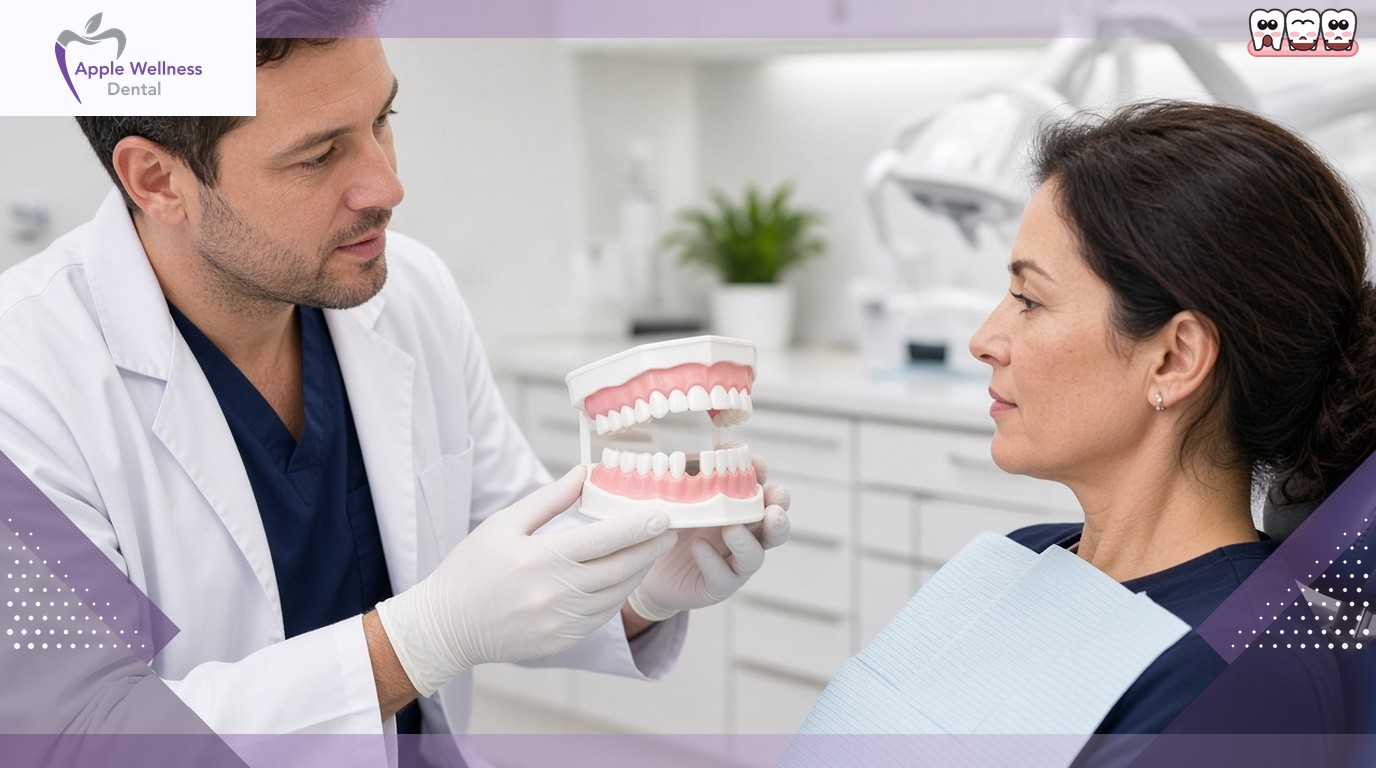
How a bridge is priced
Cleveland Clinic explains that a traditional bridge has crowns bonded to the natural teeth on either side of the gap (abutments), with artificial teeth (pontics) filling the space. A bridge may have one or more abutments and one or more pontics. Each piece has its own fee code. Alberta does not have a mandatory fee guide, according to the Government of Alberta, so the Alberta Blue Cross Dental Schedule (ABCDS) 2026 is used here as a benchmark.
Per-unit benchmark fees
| Bridge part | ABCDS 2026 code | Benchmark fee | Lab fee |
|---|---|---|---|
| Retainer (anchor), porcelain/ceramic | 67201 | $1,062.82 | Extra [L] |
| Retainer (anchor), porcelain fused to metal | 67211 | $970.95 | Extra [L] |
| Retainer, cast metal | 67301 | $1,013.47 | Extra [L] |
| Retainer, bonded partial coverage (Maryland) | 67221 | $589.49 | Extra [L] |
| Pontic, porcelain fused to metal | 62501 | $472.21 | Extra [L] |
| Pontic, porcelain/ceramic aluminous | 62502 | $472.21 | Extra [L] |
| Pontic, cast metal | 62101 | $471.17 | Extra [L] |
Bridge cost calculator by design
Using the benchmark fees above, here is what common bridge designs add up to. Totals exclude lab fees, exam, X-rays and any extraction.
| Bridge design | Units | Porcelain fused to metal | All porcelain/ceramic |
|---|---|---|---|
| Cantilever (1 anchor + 1 pontic) | 2 | $1,443.16 | $1,535.03 |
| Traditional, 1 missing tooth (2 anchors + 1 pontic) | 3 | $2,414.11 | $2,597.85 |
| Traditional, 2 missing teeth (2 anchors + 2 pontics) | 4 | $2,886.32 | $3,070.06 |
| Traditional, 3 missing teeth (2 anchors + 3 pontics) | 5 | $3,358.53 | $3,542.27 |
Hypothetical example: A Maryland bridge for one missing front tooth uses two bonded wings and one pontic. Using 67221 for each wing and 62501 for the pontic as an illustration: 2 x $589.49 + $472.21 = $1,651.19, before lab fees. Your dentist will confirm the actual codes.
Your bridge cost checklist
- ☐ Count missing teeth in a row (each is a pontic)
- ☐ Count anchor teeth (usually one on each side, or one for a cantilever)
- ☐ Ask which material: porcelain fused to metal, all ceramic or metal
- ☐ Multiply and add, using the table above
- ☐ Ask the clinic for the lab fee per unit
- ☐ Add exam and X-rays ($119.11 new-patient exam, $31.13 per periapical X-ray in the ABCDS)
- ☐ Ask whether any anchor teeth need a root canal or core first
- ☐ Ask your private insurer about major restorative coverage; CDCP does not list bridges
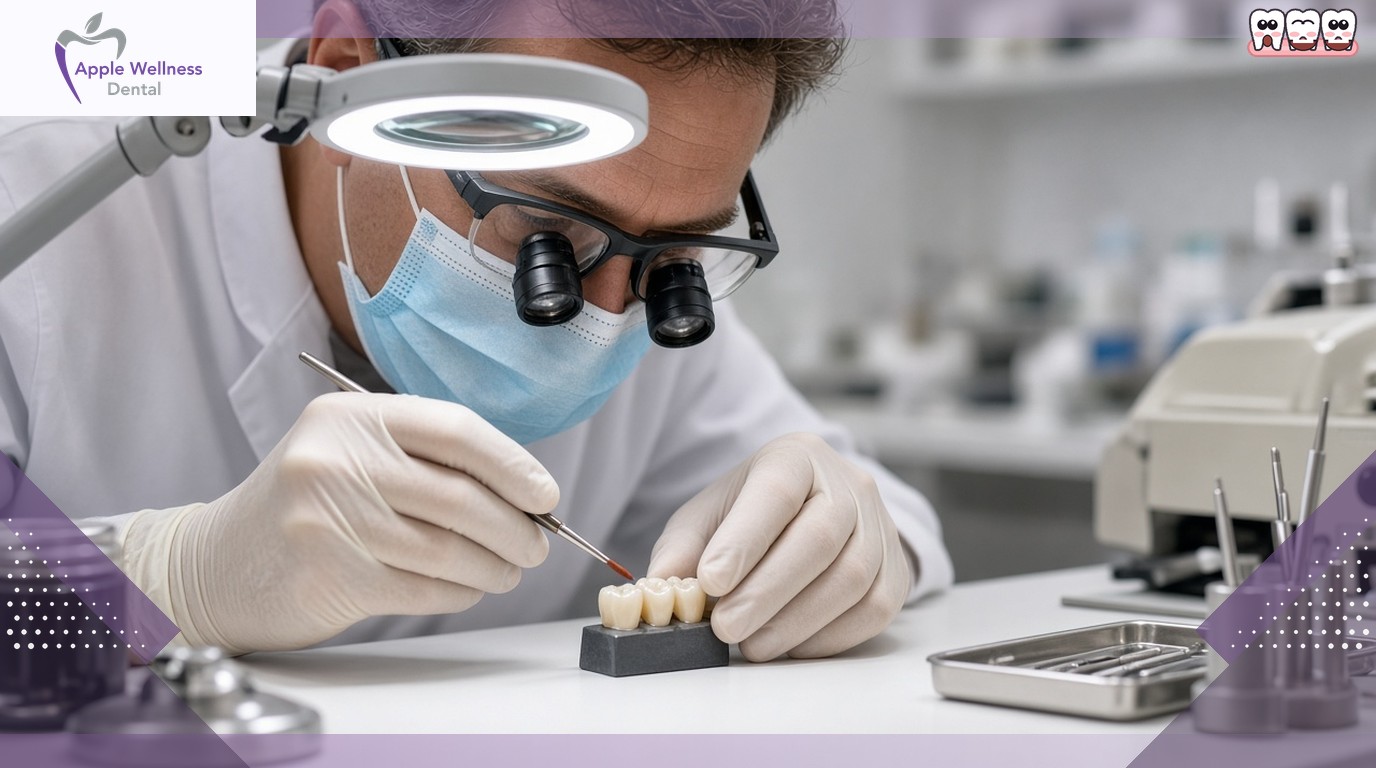
Bridge types and when each is used
Cleveland Clinic describes four main types:
| Type | How it is held | Typical use (Cleveland Clinic) |
|---|---|---|
| Traditional | Crowns on teeth either side of the gap | Most common design |
| Cantilever | Crown on one side only | Natural teeth on only one side; not as strong as traditional |
| Maryland (resin-bonded) | Metal wings bonded to the backs of neighbouring teeth | Often front teeth |
| Implant-supported | Rests on dental implants | Three or more missing teeth in a row |
Implant-supported bridges cost much more because each implant and surgery are separate fees, and Cleveland Clinic notes implants must fully fuse with the jawbone before the bridge is attached. For a comparison, see is a dental implant better than a bridge.
What the visits look like
The CDA describes the usual process: the neighbouring teeth are prepared, an impression is taken, and a temporary bridge is placed. At a second visit, once the lab has made the final bridge, the temporary is removed and the new bridge is fitted and cemented. Cleveland Clinic describes the same two-visit sequence for traditional bridges.
- Visit 1: exam, X-rays, tooth preparation, impressions, temporary bridge.
- Lab time: the bridge is made to match your teeth.
- Visit 2: fit check, bite adjustment, cementing.
- Follow-up: cleaning instructions and recall visits.
Does insurance or CDCP pay for bridges?
The CDCP coverage page lists crowns (with preauthorization), complete dentures and partial dentures (with preauthorization), but fixed bridges are not listed among covered prosthodontic services. If you have CDCP, ask your dentist about covered options for replacing a tooth, such as a partial denture.
Private plans often group bridges with major services, with a lower percentage and an annual maximum. Some have waiting periods. Ask for a pre-treatment estimate before you begin.
Value over time
Cleveland Clinic gives an average bridge lifespan of five to 15 years, and notes bridges are typically more comfortable than partial dentures and more affordable than dental implants. Its listed drawbacks: if decay or trauma damages the anchor teeth, the bridge can weaken, and plaque under the bridge can cause gum inflammation or cavities. See how long bridges last for more.
| Design (PFM benchmark) | Total | Per year over 5 years | Per year over 15 years |
|---|---|---|---|
| 3-unit | $2,414.11 | $482.82 | $160.94 |
| 4-unit | $2,886.32 | $577.26 | $192.42 |
These per-year figures are only a way to compare options. They exclude lab fees and assume the bridge lasts the full period, which depends on home care, diet and the health of the anchor teeth. Cleveland Clinic also advises avoiding extremely hard or chewy foods and not chewing on ice, pens, pencils or fingernails.
Protecting your bridge
Cleveland Clinic advises cleaning under your bridge every day with floss threaders or interproximal brushes. Our guide on cleaning under a dental bridge shows how. Regular exams and cleanings help catch decay at the anchors early.
A full estimate, start to finish
The bridge units are usually the biggest part of the bill, but not the only part. Here is how a full benchmark estimate can come together for one missing lower molar.
Hypothetical example: A new patient is missing one lower molar and chooses a porcelain-fused-to-metal 3-unit bridge. Complete exam (01103): $119.11. Two periapical X-rays (02111): 2 x $31.13 = $62.26. Two retainers (67211): 2 x $970.95 = $1,941.90. One pontic (62501): $472.21. Benchmark subtotal: $2,595.48, plus lab fees. If one anchor tooth needed a root canal first, that would be a separate fee.
| Line item | Code | Benchmark |
|---|---|---|
| Complete exam | 01103 | $119.11 |
| Periapical X-rays x 2 | 02111 | $62.26 |
| Retainers x 2 (PFM) | 67211 | $1,941.90 |
| Pontic x 1 (PFM) | 62501 | $472.21 |
| Subtotal before lab | $2,595.48 |
Why waiting can cost more
Cleveland Clinic advises replacing missing teeth as soon as possible to prevent other teeth from shifting into the gap. It also notes missing teeth can make it hard to chew and speak properly. If neighbouring teeth tip or drift, the space can change, and your dentist may need to adjust the plan. That does not mean you must decide today, but it is a reason not to put off the conversation for years.
Bridge, implant or partial denture?
Cleveland Clinic describes bridges as typically more comfortable than partial dentures and more affordable than dental implants. Each option has trade-offs:
| Option | Main pros | Main cons |
|---|---|---|
| Bridge | Fixed in place; fewer visits than an implant | Anchor teeth are prepared; needs cleaning under it |
| Implant | Does not rely on neighbouring teeth; Cleveland Clinic notes implants help preserve bone | Surgery and healing time; usually higher cost |
| Partial denture | Removable; listed under CDCP with preauthorization | Less stable; needs removal for cleaning |
For a side-by-side look at replacement options, read our tooth replacement guide.
Questions to ask before you say yes
- How many units will my bridge have, and why?
- Which material do you recommend for this spot in my mouth?
- What is the lab fee per unit?
- Do any anchor teeth need treatment first?
- Will you contact my insurer for a pre-treatment estimate?
- What is the plan if an anchor tooth has a problem later?
The CDA notes that many dentists are willing to contact a benefits carrier on your behalf to find out if a treatment is covered.
Why quotes vary
- Clinics set their own fees in Alberta.
- Lab fees depend on material and shade matching.
- Anchor teeth may need a root canal, post or core first.
- Gum or bone conditions may change the design.
- An extraction may be needed before the bridge.
Dental bridges in Airdrie
At Apple Wellness Dental, Dr. Sanjay Rajpal and Dr. Hammad Qasim care for patients from Airdrie and nearby communities at 229 1st Street SW, where the clinic has served the city since 1993. We follow the Alberta Dental Fee Guide, direct bill insurance, accept the Canadian Dental Care Plan and offer payment plans. Learn about our crowns and bridges service and ask for a written, code-by-code estimate. We do not take online bookings, so call (587) 332-6767 to speak with our team.
Frequently asked questions
How much is a 3-unit bridge in Alberta?
Using the 2026 ABCDS benchmark, a porcelain-fused-to-metal 3-unit bridge is 2 x $970.95 + $472.21 = $2,414.11, plus lab fees. All-ceramic is $2,597.85 plus lab.
Why is a bridge priced per unit?
Each anchor crown and each false tooth has its own procedure code and fee, so more missing teeth means more units.
Is a Maryland bridge cheaper?
Usually. The bonded wing retainer (67221) is $589.49 per wing, compared with $970.95 to $1,062.82 for a full crown anchor.
Does CDCP cover dental bridges?
Fixed bridges are not listed among CDCP covered services. Partial dentures (with preauthorization) are listed.
How long does a bridge last?
Cleveland Clinic gives an average of five to 15 years, depending on care and the health of the anchor teeth.
Are lab fees included?
No. Bridge codes are marked [L] in the schedule, meaning the laboratory fee is added separately.
Sources
- Alberta Blue Cross, “Alberta Blue Cross Dental Schedule 2026 – General Practitioner”
- Government of Alberta, “Dental fees in Alberta” (undated)
- Government of Canada, “Canadian Dental Care Plan: What is covered” (undated)
- Canadian Dental Association, “Bridges” (undated)
- Cleveland Clinic, “Dental Bridges” (last updated May 24, 2023)
Apple Wellness Dental
Dental care in Airdrie, Alberta. This article is general education and does not replace an examination by a dental professional. It is not medical, legal, tax or financial advice.
Missing a tooth? Ask our Airdrie team for a bridge estimate. Book a call or Contact Us, or call 587-332-6767.