
How Much Is a Tooth Extraction With Insurance? A Co-Pay Worksheet for Private Plans and CDCP
Quick Answer: How much is a tooth extraction with insurance depends on your plan’s coverage percentage. The 2026 Alberta benchmark is $144.53 for a simple extraction, $260.61 surgical and $386.47 for a bony impaction. Under the Canadian Dental Care Plan, your co-payment is 0%, 40% or 60% of CDCP fees, based on family income.
How much is a tooth extraction with insurance is really a math problem: the clinic fee, multiplied by the share your plan does not pay, plus anything above the plan’s allowed amount. This guide walks you through that math for private plans and for the Canadian Dental Care Plan (CDCP), using official numbers only. If you have no coverage, see our tooth extraction cost without insurance guide instead.
Last updated: November 3, 2026. Main source: Alberta Blue Cross Dental Schedule 2026 and the CDCP coverage page. Full links are in the Sources section.
Key Takeaways
- Step 1: know the procedure code. Simple, surgical and impacted extractions have different fees.
- Step 2: know your plan percentage. Private plans vary; CDCP pays 100%, 60% or 40% of its own fees by income.
- Step 3: ask about the gap. If the clinic fee is above what your plan allows, you may pay the difference.
- Ask for a pre-treatment estimate in writing before the appointment when you can.
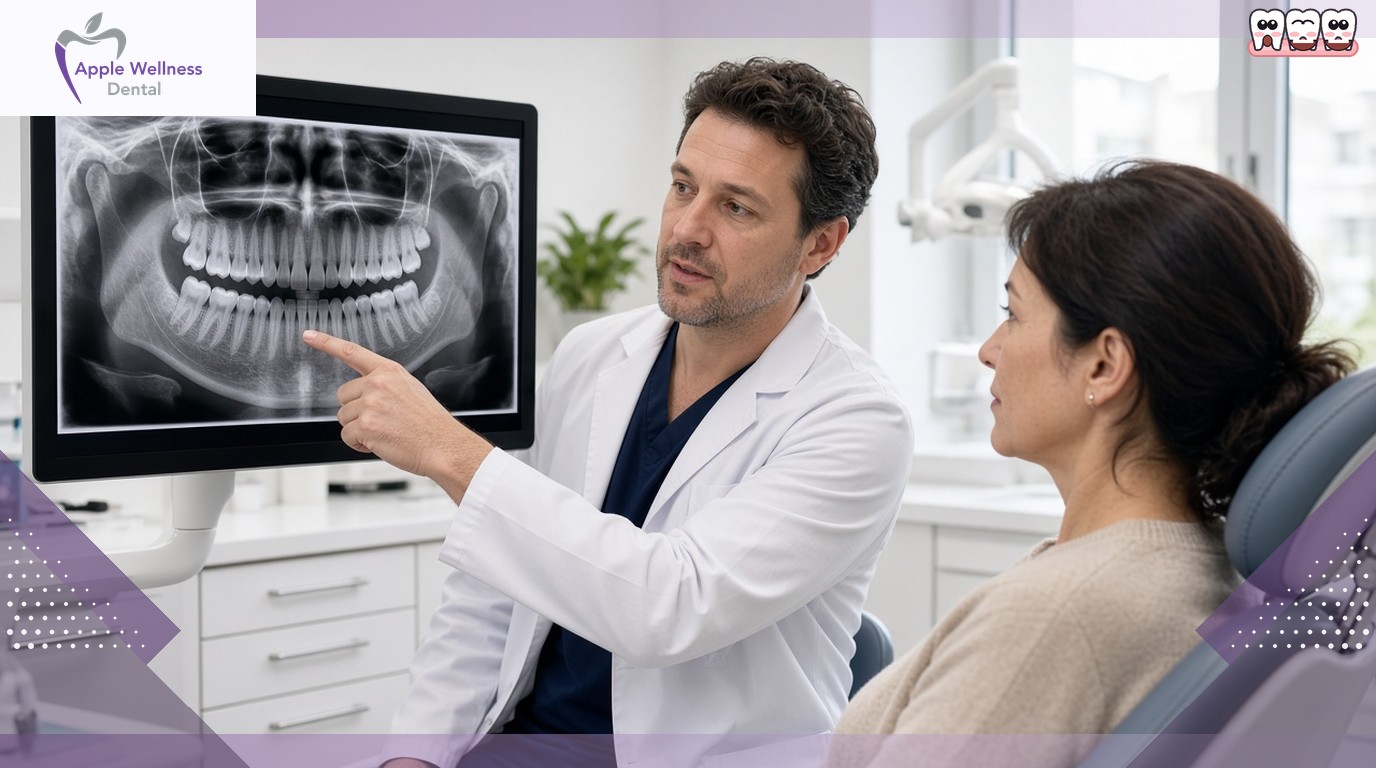
Step 1: the fee before insurance
Alberta has no mandatory fee guide, and dentists set their own fees, according to the Government of Alberta. The Alberta Blue Cross Dental Schedule (ABCDS) 2026 is a common benchmark. These are its general practitioner fees for the most common extraction codes:
| Type of extraction | ABCDS 2026 code | Benchmark fee |
|---|---|---|
| Erupted tooth, uncomplicated (simple) | 71101 | $144.53 |
| Each additional tooth, same quadrant, same visit | 71109 | $144.53 |
| Erupted tooth, surgical approach (flap and/or sectioning) | 71201 | $260.61 |
| Impaction, soft tissue | 72111 | $260.61 |
| Impaction, flap plus bone removal or sectioning | 72211 | $386.47 |
An exam and X-ray are usually needed first. The ABCDS lists $119.11 for a complete new-patient exam (01103), $67.11 for a recall exam (01202) and $31.13 for a single periapical X-ray (02111). For a broader cost overview, read how much is tooth extraction.
Step 2: your coverage percentage
Your share depends on which kind of coverage you have. Many Albertans have a private plan through work, some have CDCP, and a few have both.
Private dental plans
Workplace and individual plans set their own percentages, annual maximums and deductibles. Extractions are often grouped with basic or oral surgery services, but every plan is different. Your benefits booklet, or a call to your insurer, will tell you:
- ☐ The percentage paid for extractions (oral surgery)
- ☐ Whether a deductible applies and how much is left this year
- ☐ Your annual maximum and how much you have used
- ☐ Whether the plan pays based on a fee guide, and which one
- ☐ Whether a waiting period applies for new members
- ☐ Whether the clinic can submit a pre-treatment estimate
- ☐ Whether sedation is covered and under what conditions
Canadian Dental Care Plan (CDCP)
The CDCP coverage page lists oral surgery, including removal of teeth and roots, among services that could be covered when recommended by an oral health provider. Coverage is a share of CDCP established fees, based on adjusted family net income:
| Adjusted family net income | CDCP covers | You pay (co-payment) |
|---|---|---|
| Lower than $70,000 | 100% of CDCP fees | 0% of CDCP fees |
| $70,000 to $79,999 | 60% of CDCP fees | 40% of CDCP fees |
| $80,000 to $89,999 | 40% of CDCP fees | 60% of CDCP fees |
The CDCP also states that its fees may not be the same as what providers charge. You may pay additional charges if the cost is more than the CDCP reimburses, or if you and your provider agree to services the plan does not cover. It advises asking your provider about any uncovered costs before treatment. Eligibility rules are on the CDCP qualify page.

Step 3: the gap between the fee and the allowed amount
Even with 100% coverage, you can owe money if the clinic fee is higher than what your plan allows. This is sometimes called a balance or additional charge. Ask the clinic two questions: what is your fee for this code, and what does my plan allow for it?
Worked examples
The examples below use the ABCDS 2026 benchmark as the clinic fee to show the math. CDCP established fees and private plan allowances are set separately and may differ from these numbers.
Hypothetical example: A patient has a private plan that pays 80% for extractions, with no deductible left. A simple extraction (71101) at $144.53: plan pays 80% = $115.62. Patient pays $28.91. If the plan allows less than $144.53, the patient also pays the difference.
Hypothetical example: A CDCP member with income of $75,000 (40% co-payment) needs a surgical extraction (71201). If the CDCP fee were $260.61, the co-payment would be 40% = $104.24. Any amount the clinic charges above the CDCP fee is an additional charge.
Hypothetical example: A CDCP member with income below $70,000 (0% co-payment) needs a bony impaction removed (72211). If the clinic fee equals the CDCP fee, the member pays $0. If the clinic fee is higher, the member pays only the difference.
| Scenario (hypothetical, using $260.61 fee) | Plan share | You pay |
|---|---|---|
| Private plan at 80% | $208.49 | $52.12 |
| Private plan at 50% | $130.31 | $130.30 |
| CDCP, 0% co-pay | $260.61 | $0.00 |
| CDCP, 40% co-pay | $156.37 | $104.24 |
| CDCP, 60% co-pay | $104.24 | $156.37 |
These assume the clinic fee and the plan fee are the same. In real life, check both numbers.
If you have more than one plan
Some people have two private plans, for example their own workplace plan and a spouse’s plan. In that case, the clinic usually submits to the primary plan first and the secondary plan second, which can reduce or remove your share. The rules for which plan is primary are set by the insurers, so call both before treatment. The CDCP qualify page states that you cannot be eligible if you have access to private dental insurance or coverage, including through your work, a family member’s work or a pension plan, even if you never use it. Coverage through a government social program is different: you could still qualify, and the plans may coordinate so there is no duplication. Eligibility also requires adjusted family net income under $90,000.
How to read your benefits statement
After a claim, your insurer sends an explanation of benefits. It usually lists the code, the amount submitted, the eligible amount and the amount paid. The difference between submitted and paid is what you owe. Line up each code with the estimate you got before treatment.
| Line on the statement | What it means | What to check |
|---|---|---|
| Procedure code | The service billed, for example 71101 | Matches the treatment you had |
| Submitted amount | The clinic fee | Matches the written estimate |
| Eligible amount | What the plan allows for that code | Lower than submitted means a gap |
| Plan paid | Plan share of the eligible amount | Matches your coverage percentage |
| Patient portion | What you owe the clinic | Submitted minus plan paid |
Why the extraction type changes your bill
Your dentist chooses the code based on the tooth, not on price. A tooth that is fully above the gum and comes out in one piece is usually a simple extraction. A broken tooth, curved roots or a tooth that needs to be cut into pieces may need a surgical approach. Impacted teeth, usually wisdom teeth, are coded by how much gum and bone covers them. Because the code can change after an X-ray, ask for your estimate after the X-ray, not before.
Costs people forget
- Exam and X-ray before the extraction.
- Additional teeth in the same visit (code 71109 or similar).
- Sedation, if you choose it; CDCP lists nitrous oxide and oral sedation, with deeper sedation requiring preauthorization.
- Follow-up visits if healing is slow.
- A replacement tooth later, such as a bridge, implant or denture.
Wisdom teeth often involve surgical or impaction codes; see wisdom tooth extraction cost for that case.
Pre-treatment estimate: your best protection
A pre-treatment estimate (sometimes called a predetermination) is when the clinic sends the planned codes to your insurer before treatment. The insurer replies with what it will pay. For CDCP, some services require preauthorization, and the plan advises patients to confirm costs with the provider before accepting treatment. For urgent cases, such as severe pain or swelling, treatment may need to happen first; see our emergency dental treatment page.
After the extraction
Insurance covers the procedure, but healing is up to you. MyHealth Alberta advises biting on gauze and changing it every 30 to 60 minutes until bleeding stops, not rinsing hard, not using a straw for the first few days, and choosing soft foods like gelatin or soup. Following aftercare helps avoid extra visits for complications like dry socket. Our pain after extraction guide explains what is normal.
Tooth extractions in Airdrie
At Apple Wellness Dental, Dr. Sanjay Rajpal and Dr. Hammad Qasim care for patients from Airdrie and nearby communities at 229 1st Street SW, where the clinic has served the city since 1993. We follow the Alberta Dental Fee Guide, direct bill insurance, accept the Canadian Dental Care Plan and offer payment plans. We can submit a pre-treatment estimate to your insurer and explain your share before we start. We do not take online bookings, so call (587) 332-6767 to speak with our team.
Frequently asked questions
How much is a simple tooth extraction with insurance?
It depends on your plan. The 2026 Alberta benchmark is $144.53 (code 71101). If your plan pays 80% of that, your share is about $28.91, plus any amount above the plan allowance.
Does CDCP cover tooth extractions?
Yes. The CDCP lists removal of teeth and roots under oral surgery services that could be covered when recommended by a provider.
What is the CDCP co-payment?
0% if adjusted family net income is under $70,000, 40% for $70,000 to $79,999, and 60% for $80,000 to $89,999, of CDCP established fees.
Can I still pay something with 100% CDCP coverage?
Yes. If the clinic fee is higher than the CDCP fee, or you choose uncovered services, you may pay additional charges.
Is a surgical extraction more expensive?
Yes. The benchmark for a surgical erupted extraction (71201) is $260.61 and for a bony impaction (72211) is $386.47.
How do I know my exact cost?
Ask the clinic for the codes and fees, then request a pre-treatment estimate from your insurer or confirm with CDCP rules.
Sources
- Alberta Blue Cross, “Alberta Blue Cross Dental Schedule 2026 – General Practitioner”
- Government of Alberta, “Dental fees in Alberta” (undated)
- Government of Canada, “Canadian Dental Care Plan: What is covered” (undated)
- Government of Canada, “Canadian Dental Care Plan: Do you qualify” (undated)
- MyHealth Alberta, “Tooth Extraction: Care Instructions” (current as of July 31, 2024)
Apple Wellness Dental
Dental care in Airdrie, Alberta. This article is general education and does not replace an examination by a dental professional. It is not medical, legal, tax or financial advice.
Questions about your coverage? Call our Airdrie team. Book a call or Contact Us, or call 587-332-6767.