
When Does Bleeding Stop After Wisdom Tooth Extraction? An Hour-by-Hour Timeline
Quick Answer: When does bleeding stop after wisdom tooth extraction? For most people, steady bleeding settles within the first few hours with gauze pressure, and light oozing is normal on the day of surgery and sometimes the next day. MyHealth Alberta advises calling your dentist or oral surgeon if you still have bleeding 24 hours after surgery.
When does bleeding stop after wisdom tooth extraction is one of the first questions people ask once they get home with a mouthful of gauze. The honest answer is that it fades in stages rather than stopping all at once. This guide walks through what is typical hour by hour, what pink saliva means, and the specific points at which you should pick up the phone.
Last updated: November 3, 2026. Main source: MyHealth Alberta, “Wisdom Tooth Removal: What to Expect at Home” and “Oral Surgery: What to Expect at Home” (Alberta Health Services). Full links are in the Sources section.
Key Takeaways
- Bite on gauze first. Official leaflets advise firm pressure for 20 to 30 minutes at a time, repeated if needed.
- Light oozing is expected. MyHealth Alberta says it is normal for the day of surgery and sometimes the following day.
- Pink saliva is not the same as bleeding. A little blood mixed with saliva can look like a lot.
- Spots on the pillow the next morning can be normal, according to Nova Scotia Health.
- Call if bleeding is still going at 24 hours, or sooner if it is heavy and pressure does not slow it.

Hour-by-hour bleeding timeline
Every extraction is different. Impacted teeth that needed bone removal or stitches tend to ooze longer than a simple upper wisdom tooth. Use this timeline as a general picture, not a promise.
| Time after surgery | What is typical | What to do |
|---|---|---|
| 0 to 1 hour | Active bleeding into the gauze your dentist placed | Keep firm, steady biting pressure. Do not keep checking or talking with gauze in (MyHealth Alberta). |
| 1 to 4 hours | Bleeding slows to oozing; gauze comes out pink or lightly red | Change gauze every 30 to 60 minutes only if it is soaked (MyHealth Alberta). Rest with head raised. |
| 4 to 12 hours | Light oozing, pink-tinged saliva | Stop gauze once it comes out only lightly pink. Avoid spitting, rinsing and hot drinks. |
| Overnight | Small spots of blood on the pillow | Nova Scotia Health says this can be normal. Sleep with your head propped up. |
| 12 to 24 hours | Occasional pink saliva, especially after eating or talking | Gentle care only. Do not rinse for 24 hours (CDA). |
| 24 hours and later | Bleeding should have stopped; brief pink tinge after brushing near the site can happen | If you still have bleeding at 24 hours, call your dentist (MyHealth Alberta). |
Why bleeding fades in stages
After a tooth comes out, a blood clot forms in the socket. That clot is the first stage of healing and it also acts as a plug. In the first hour, the clot is soft and easily disturbed, which is why pressure matters so much. Over the next several hours it firms up, and active bleeding gives way to oozing from the surrounding gum.
Saliva makes oozing look worse than it is. A small amount of blood will tint a whole mouthful of saliva pink. If you are swallowing comfortably and the gauze is not filling with bright red blood, you are usually seeing normal oozing.
How to use gauze properly
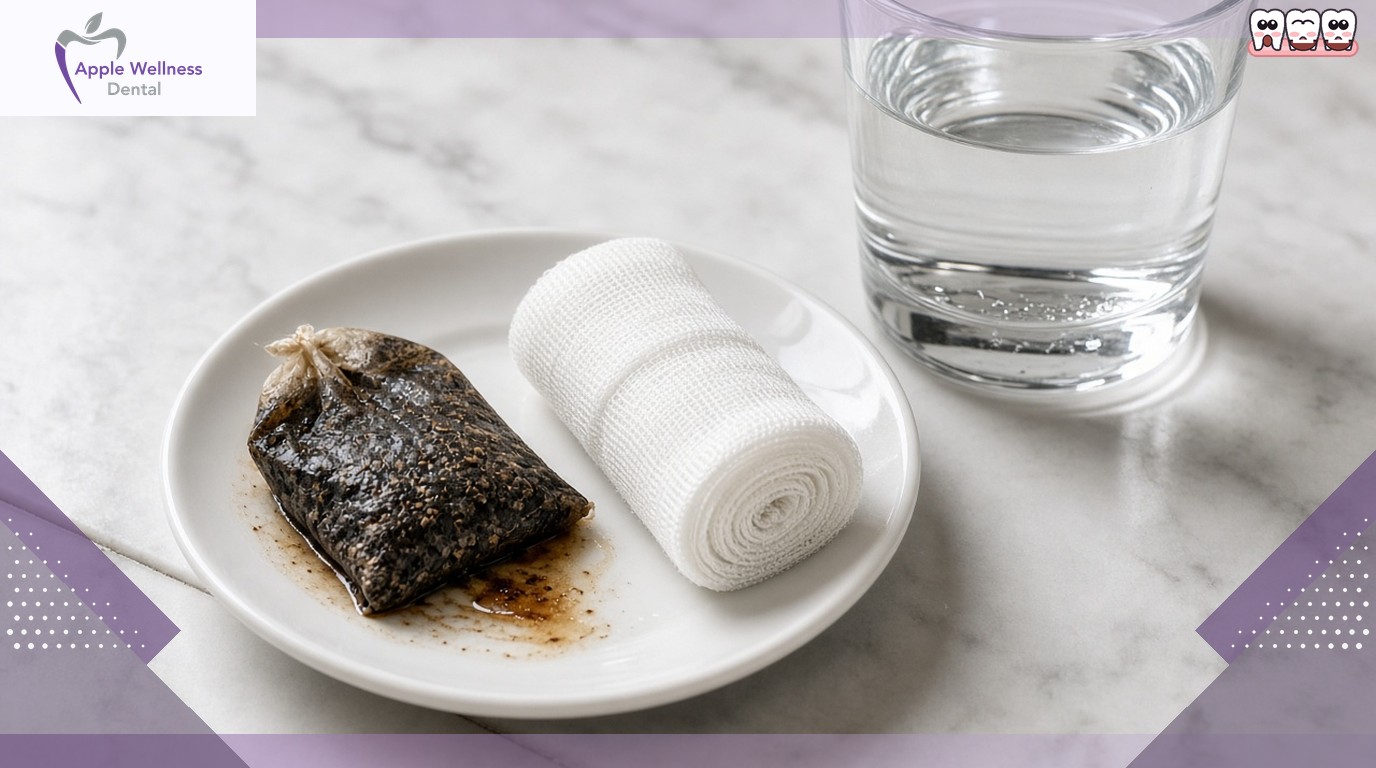
Gauze only works if it presses directly on the socket. Nova Scotia Health advises biting firmly for 20 to 30 minutes on a folded, wet gauze pad or a moist tea bag, and repeating two or three times if needed. MyHealth Alberta notes that using gauze too long, or talking with it in place, can actually increase bleeding by disturbing the clot.
- ☐ Wash your hands, then fold a clean gauze pad into a thick square
- ☐ Dampen it slightly with clean water so it does not stick to the clot
- ☐ Place it directly over the socket, not on the teeth beside it
- ☐ Bite down firmly and steadily for 20 to 30 minutes without checking
- ☐ Sit upright or lie back with your head raised on pillows
- ☐ If gauze comes out soaked, repeat with a fresh pad; if only lightly pink, stop using gauze
- ☐ Try a moist black tea bag in place of gauze if bleeding continues (MyHealth Alberta, Nova Scotia Health)
Hypothetical example: A 22-year-old has two lower wisdom teeth removed at 9 a.m. By 11 a.m. the gauze is coming out pink rather than red, so they stop changing it every half hour. At 6 p.m. they notice pink saliva after dinner, bite on a damp pad for 30 minutes, and it settles. The next morning there are two small spots on the pillow. By early afternoon, about 28 hours after surgery, they notice no further oozing. At no point was gauze filling with bright red blood, so this followed a normal pattern.
Things that restart bleeding
Most late bleeding comes from something disturbing the clot. Official aftercare sheets repeat the same list:
- Exercise and straining. MyHealth Alberta says physical activity may increase bleeding, and the CDA advises not straining for 2 days.
- Lying flat. MyHealth Alberta advises propping your head up rather than lying flat.
- Rinsing, spitting and straws. The CDA says not to rinse for 24 hours. Sucking and spitting create pressure that can lift the clot.
- Hot drinks and hot food. The CDA notes that hot liquids increase blood flow and the wound can start to bleed again.
- Smoking. MyHealth Alberta advises no smoking for at least 24 hours.
- Poking the site. Fingers and tongue can dislodge the clot.
When bleeding is not normal
Most people never need more than the gauze steps above. But some bleeding needs a call, either to your dentist or, after hours, to Health Link at 811.
| Situation | What to do |
|---|---|
| Still bleeding 24 hours after surgery | Call your dentist or oral surgeon (MyHealth Alberta) |
| Gauze fills with bright red blood again and again despite 2 to 3 rounds of firm pressure | Call your dentist now; after hours, call 811 |
| Bleeding plus dizziness, fainting or feeling very unwell | Seek urgent care; call 911 in an emergency |
| Bleeding that starts again days later with new pain or swelling | Call your dentist; this can signal infection or a problem with healing |
| You take blood thinners and bleeding seems heavier than expected | Call your dentist; do not stop any medicine without medical advice |
For a deeper look at the warning signs, see what happens if bleeding does not stop after tooth extraction. For step-by-step techniques, our guide on how to stop bleeding after wisdom tooth extraction goes further, and how long will it bleed after wisdom tooth extraction covers duration in more general terms.
Why some people ooze longer than others
The timeline above is a general pattern. Several factors can make bleeding last a little longer, and none of them automatically means something is wrong:
- Surgical extractions. Teeth that were impacted, needed the gum opened, bone removed or stitches placed usually leave a larger wound than a simple extraction.
- Several teeth at once. Having all four wisdom teeth out means four sites that can each ooze.
- Medicines that affect clotting. Blood thinners and some other medicines can lengthen bleeding. Tell your dentist about every medicine and supplement before surgery, and never stop a prescribed medicine on your own.
- Activity and habits. Exercise, smoking and hot drinks in the first day are common reasons a site that had settled starts again.
If any of these apply to you, ask your dentist before surgery what amount of oozing to expect and who to call after hours. Having that plan in writing makes the first night far less stressful.
Small habits that help
- Rest for the remainder of the day and keep your head raised. See how to sleep after tooth extraction.
- Stick to soft, cool or lukewarm food for the first day. See what you can eat after wisdom tooth extraction.
- Take pain medicine exactly as your dentist or pharmacist directs.
- Brush other teeth gently and avoid the site as instructed.
Wisdom tooth aftercare in Airdrie
At Apple Wellness Dental, Dr. Sanjay Rajpal and Dr. Hammad Qasim send patients home with gauze and written instructions, and we are glad to answer questions during clinic hours if healing does not seem to match what you expected. If you are worried about bleeding that will not settle, call us at (587) 332-6767 or visit our emergency dental treatment page.
Our clinic has served Airdrie from 229 1st Street SW since 1993. We follow the Alberta Dental Fee Guide, direct bill insurance and accept the Canadian Dental Care Plan.
Frequently asked questions
Is it normal to bleed the day after wisdom tooth extraction?
Light oozing can continue into the next day. MyHealth Alberta says light oozing is normal for the day of surgery and sometimes the following day. Steady bleeding that fills gauze is not typical at that point.
How long should I keep gauze in after wisdom tooth removal?
Bite firmly for 20 to 30 minutes at a time and change it only if soaked. MyHealth Alberta advises changing gauze every 30 to 60 minutes and notes that keeping it in too long can increase bleeding.
Why is there blood on my pillow after wisdom tooth extraction?
Small spots of blood on the pillow the next morning can be normal, according to Nova Scotia Health. Sleeping with your head raised helps reduce overnight oozing.
Does a tea bag help stop bleeding after wisdom tooth extraction?
A damp black tea bag pressed on the socket is suggested by MyHealth Alberta and Nova Scotia Health as an option if gauze is not working. Bite on it firmly for 20 to 30 minutes.
When should I worry about bleeding after wisdom tooth removal?
Call your dentist if bleeding is still going 24 hours after surgery, or sooner if gauze keeps filling with bright red blood despite firm pressure. After hours, Albertans can call 811.
Can exercise make my wisdom tooth socket bleed again?
Yes. MyHealth Alberta says physical activity may increase bleeding, and the CDA advises not straining for 2 days after oral surgery.
Sources
- MyHealth Alberta, “Wisdom Tooth Extraction: What to Expect at Home” (current as of July 31, 2024)
- MyHealth Alberta, “Tooth Extraction” (adapted by Alberta Health Services, December 2, 2025)
- Nova Scotia Health, “After a Dental Extraction” (September 2026)
- Canadian Dental Association, “Care after Minor Oral Surgery” (undated)
- NHS, “Wisdom tooth removal” (last reviewed June 12, 2024)
- Health Link 811, Alberta (undated)
Apple Wellness Dental
Dental care in Airdrie, Alberta. This article is general education and does not replace an examination by a dental professional. It is not medical, legal, tax or financial advice.
Worried about bleeding after an extraction? Call our Airdrie team. Book a call or Contact Us, or call 587-332-6767.