
How to Sleep After Tooth Extraction: A Night-by-Night Guide for the First Week
Quick Answer: How to sleep after tooth extraction: keep your head raised on an extra pillow or two, lay a towel over the pillow for any pink saliva, and take the gauze out before you fall asleep. Rest, take pain relief as your dentist advised, and call if bleeding is heavy or pain keeps getting worse.
Knowing how to sleep after tooth extraction matters because the first nights are when the blood clot is newest and swelling is building. Most people sleep fine with a few simple steps. The questions are usually practical: how many pillows, what to do with the gauze, and whether blood on the pillow is normal.
This guide brings together bedtime advice from the Canadian Dental Association (CDA), MyHealth Alberta, NHS hospital leaflets and university oral surgery clinics, and shows where they differ. Your own dentist’s instructions come first.
Last updated: October 20, 2026. Main sources: CDA care after minor oral surgery (undated), MyHealth Alberta tooth extraction pages (2024 and 2025), Kettering General Hospital NHS (September 2024), Central and North West London NHS (February 2023), Western Australia Dental Health Services (September 2025) and Dartmouth Health oral surgery instructions (undated). Full links are at the end.
Key Takeaways
- Head up: rest and keep your head raised (CDA); an extra pillow helps (NHS leaflets).
- Gauze out: do not leave gauze in overnight or sleep with it (Dartmouth Health).
- Protect the pillow: a towel catches blood-stained saliva (NHS).
- Plan pain relief: several leaflets say to take painkillers before the numbness wears off, if they are safe for you.
- Know when to call: heavy bleeding after 4 hours, fever, vomiting or worsening pain (CDA). Health Link 811 answers 24/7.
How to sleep after tooth extraction: what official aftercare advice says
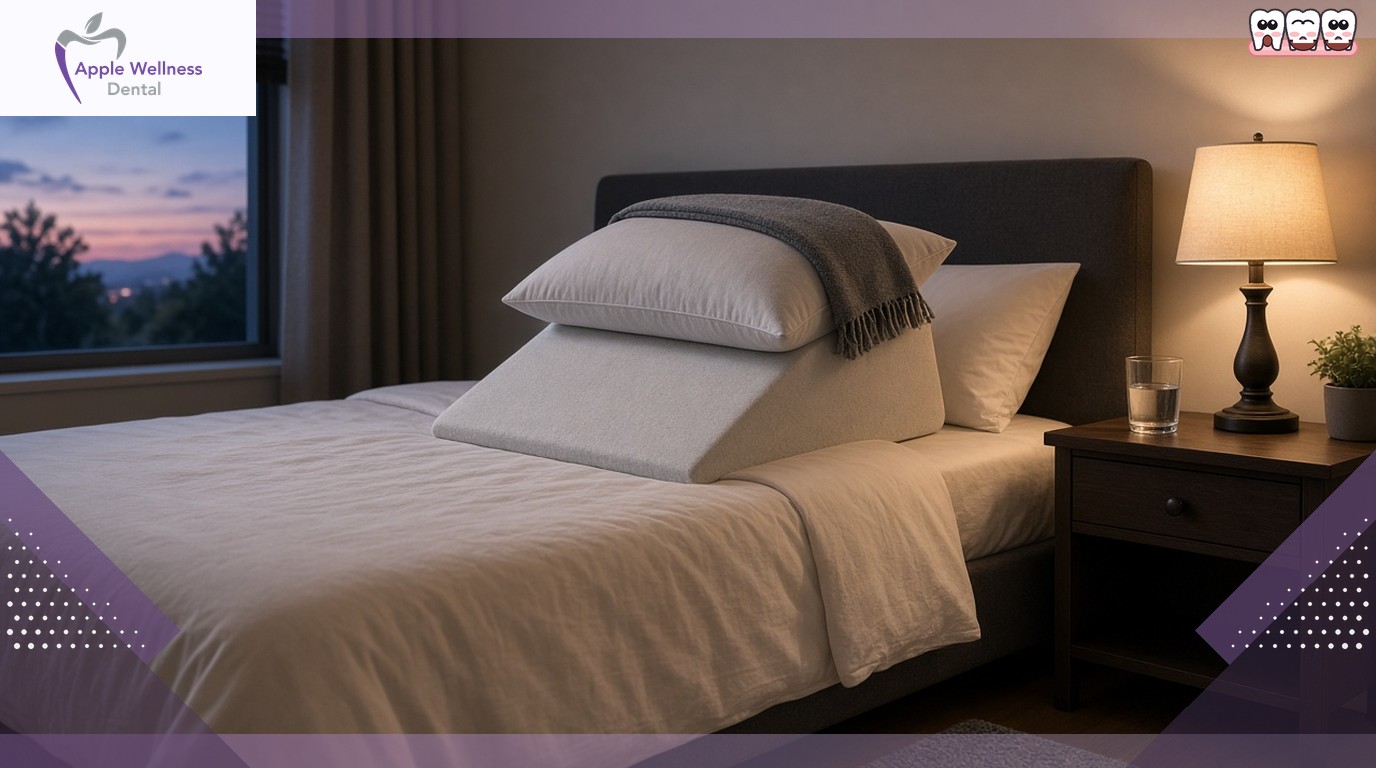
Every source we checked recommends the same basic position: head higher than usual. Here is what each one says:
- The CDA says to rest and keep your head raised, because rest slows the circulation of blood, which helps stop bleeding and helps you heal faster.
- Kettering General Hospital NHS says that when lying down you should raise your head with an extra pillow to protect the blood clot and reduce the risk of bleeding.
- A Central and North West London NHS leaflet says you may find it more comfortable to sleep with an extra pillow under your head and a towel to catch any blood-stained saliva.
- Western Australia Dental Health Services advises adults who had surgical extractions to sleep with 2 pillows so the head is slightly elevated.
- Bedfordshire Hospitals NHS says to keep your head elevated using multiple pillows to reduce swelling, and that some blood stains on bed linen when you sleep may be expected.
Dartmouth Health puts it simply: keep the head elevated, higher than the heart. So the core answer to how to sleep after tooth extraction is to sleep propped up, not flat. For first-night specifics, see our guide to sleeping the first night after tooth extraction.
Gauze and sleep: take it out first
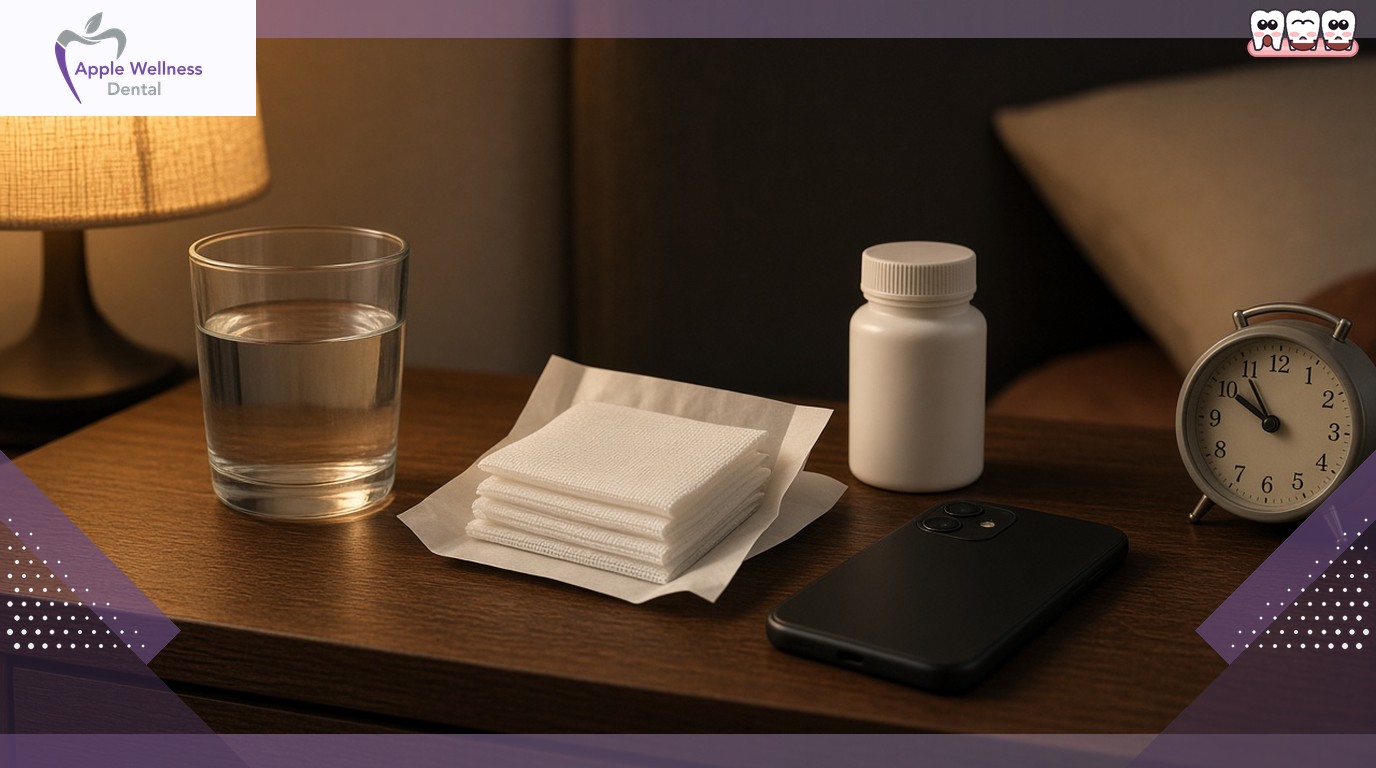
Gauze helps a clot form, but it is not meant to stay in while you sleep. Dartmouth Health’s oral surgery instructions say: do not leave the gauze in overnight, and never let a patient sleep unattended or for long periods with gauze packs in the mouth. It suggests discontinuing gauze when bleeding stops, usually after 3 to 4 hours.
MyHealth Alberta says to change the gauze every 30 to 60 minutes during the first 24 hours until bleeding stops, and to remove it once you cannot see any bleeding. It adds that using a gauze pad for too long, or talking with it in place, can cause you to bleed more or for longer. Light oozing is normal on the day of surgery and sometimes the next day.
If you are still oozing at bedtime, sit upright and bite firmly on a fresh, damp gauze pad before you lie down. Leaflets give 15 to 30 minutes of firm pressure. Then remove the gauze and lie back with your head raised. Our article on sleeping with gauze after tooth extraction goes into more detail.
Night-by-night plan for the first week
Recovery is different for each person and each extraction. Use this as a guide, with the source for each point:
| Night | What to expect | Bedtime steps |
|---|---|---|
| Night 1 | Bleeding for the first hour or 2; oozing for up to 24 hours (CDA). The most pain is often in the first 24 to 48 hours (CDA). | Head raised on an extra pillow; towel on the pillow (NHS). Gauze out before sleep (Dartmouth Health). No rinsing in the first 24 hours (CDA). Pain relief as advised. |
| Nights 2 and 3 | Swelling peaks at about 36 to 48 hours (WA Dental Health Services); one US clinic says day 3 (University of Washington). | Keep sleeping propped up. Gentle warm salt water rinses usually start after 24 hours (CDA, MyHealth Alberta). Use cold or warm compresses only as your dentist advised (see the next section). |
| Nights 4 to 7 | Swelling starts to go down after 4 to 5 days (WA) and may last 5 to 7 days; bruising can follow (CDA). Jaw may be stiff for up to 7 to 10 days (CDA). | Return to your usual pillow height as swelling settles. Watch for pain that gets worse instead of better. |
A new, throbbing pain around days 3 to 5 that spreads toward the ear can be a sign of dry socket (Kettering General Hospital NHS). That is a reason to call, not to sleep it off. See our guide on how dry socket is treated.
Where the advice differs: cold, heat and pain relief at bedtime
| Topic | What different sources say |
|---|---|
| Cold packs | MyHealth Alberta: ice or a cold pack on the cheek for 10 to 20 minutes at a time, every 1 to 2 hours for the next 3 days, when you are awake, with a thin cloth between ice and skin. CDA: cold compress, 10 minutes on and 10 off, on the first day. |
| Heat | CDA: something warm on the swollen area from the second day, never hot enough to burn. University of Washington oral surgery: no heat for the first 3 days unless your surgeon says so. |
| Pain relief timing | University Hospitals Dorset NHS: take painkillers such as paracetamol or ibuprofen before the numbness wears off, if they are okay for you. CNWL NHS leaflet: about an hour after the extraction. |
| Which painkillers | CNWL NHS leaflet: do not take aspirin unless it was prescribed, as it may increase bleeding. WA Dental Health Services: do not take aspirin or ibuprofen, as this may lead to further bleeding. Other leaflets list ibuprofen as suitable. Ask your dentist or pharmacist which is right for you. |
The CDA also says not to take more medication than advised and not to drink alcohol when taking pain relief medication. Note that MyHealth Alberta’s ice advice is for when you are awake, so you do not need to set alarms to ice through the night. For more on comfort, see our guides on relieving pain after tooth extraction and how long swelling lasts.
Back, side or propped up?
The official leaflets we checked do not say which side to sleep on. They focus on keeping the head raised and protecting the clot: no rinsing for 24 hours, no straws for the first few days, and not rubbing the area with your tongue (MyHealth Alberta). Lying back on raised pillows is the simplest way to follow that advice. If you prefer your side, ask your dentist, especially if you had teeth removed on both sides. Our article on sleeping on your side after tooth extraction looks at this in more depth.
Bedtime checklist for the first few nights
- ☐ Stack an extra pillow (or two) so your head is higher than your heart.
- ☐ Lay an old towel over the pillow.
- ☐ If you are still oozing, bite on fresh damp gauze for 15 to 30 minutes while sitting up, then take it out.
- ☐ Take pain relief as your dentist or pharmacist advised; no alcohol with pain medication (CDA).
- ☐ No rinsing on night 1; from the next day, rinse gently only as instructed.
- ☐ Keep water, spare gauze, your aftercare sheet and the clinic phone number by the bed.
- ☐ Know the numbers: 911 for emergencies, Health Link 811 for 24/7 nurse advice.
Hypothetical example: a sensible first night
Hypothetical example (not a real patient): Jordan has a lower molar removed at 3 p.m. By 9 p.m. the gauze shows only a pink tinge, so Jordan removes it, takes the pain reliever the dentist recommended and props up on two pillows with a towel on top. At 2 a.m. Jordan notices a little blood on the towel, sits up, bites on fresh damp gauze for 20 minutes and the oozing stops. Jordan takes the gauze out and goes back to sleep. If the bleeding had kept going after repeated pressure, Jordan would have called for advice.
When to call instead of sleeping it off
According to the CDA, call your dentist or oral surgeon right away if:
- You are bleeding a lot and it has been 4 hours or longer since your surgery.
- You feel like you are going to throw up, or you are throwing up.
- You have a fever.
- You have pain that does not get better, and it has been 1 full day or longer since surgery.
- Your swelling is still getting worse, and it has been 2 days or longer since surgery.
MyHealth Alberta says to call 911 if you pass out or have trouble breathing, and to call your dentist or seek care for pain that does not improve with pain medicine, loose stitches, new or more bleeding, or signs of infection such as increased pain, swelling, warmth or redness, pus or fever. At night in Alberta, Health Link 811 is a free 24/7 line where registered nurses help you decide if you need urgent care.
Extraction aftercare support in Airdrie
Apple Wellness Dental has provided dental care in Airdrie since 1993 from 229 1st Street SW. Our general dentists, Dr. Sanjay Rajpal and Dr. Hammad Qasim, provide tooth extractions and wisdom tooth removal, and we offer emergency dental treatment with same-day emergency appointments available. If you are unsure how to sleep after tooth extraction in your situation, or something does not feel right, call us at (587) 332-6767 during office hours: Monday and Tuesday 8 to 5, Wednesday 8 to 4, Thursday 9 to 7 and Friday 8 to 3:30.
Outside office hours, call Health Link 811 for nurse advice, or 911 in an emergency. We follow the Alberta Dental Fee Guide, bill most private insurers directly and accept the Canadian Dental Care Plan (CDCP).
Frequently asked questions
How should I position my head when I sleep after a tooth extraction?
Keep your head raised. The CDA says to rest and keep your head raised, and NHS leaflets suggest an extra pillow when lying down. Western Australia’s Dental Health Services suggests 2 pillows after a surgical extraction.
Can I sleep with gauze in my mouth?
No. Dartmouth Health’s oral surgery instructions say not to leave gauze in overnight and never to let a patient sleep unattended with gauze packs in the mouth. MyHealth Alberta warns about swallowing gauze and says to stop using it once you cannot see bleeding.
Is it normal to have blood on my pillow the next morning?
Some pink, blood-stained saliva is normal at first. Bedfordshire Hospitals says some blood stains on bed linen may be expected, and an NHS leaflet suggests a towel on the pillow. Fresh, heavy bleeding is different and needs a call to your dentist.
Which side should I sleep on after a tooth extraction?
The official leaflets we checked do not name a side. They focus on keeping your head raised and not disturbing the socket. Ask your dentist if you had extractions on both sides or had stitches.
How many nights should I sleep propped up?
Sources say to keep your head raised while swelling and bleeding settle. The CDA says swelling may last 5 to 7 days, and Western Australia’s Dental Health Services says it peaks around 36 to 48 hours.
When should I call instead of going back to sleep?
Call 911 if you have trouble breathing or pass out. Call your dentist if you are still bleeding a lot 4 hours after surgery, have a fever, are vomiting, or pain is not getting better a day later. Health Link 811 gives 24/7 nurse advice in Alberta.
Sources
- Canadian Dental Association, “Care after Minor Oral Surgery” (undated): cda-adc.ca
- MyHealth Alberta, “Tooth Extraction” (adapted by Alberta Health Services, 2025): myhealth.alberta.ca
- MyHealth Alberta, “Tooth Extraction: Care Instructions” (current as of July 31, 2024): myhealth.alberta.ca
- Kettering General Hospital NHS Foundation Trust, “Advice Following Oral Surgery Under Local Anaesthetic” (September 2024): kgh.nhs.uk
- Central and North West London NHS Foundation Trust (with Oxford Health and Berkshire Healthcare), “Looking after your mouth after a dental extraction” (February 2023): oxfordhealth.nhs.uk
- Bedfordshire Hospitals NHS Foundation Trust, “Removal of Teeth, Post-Operative Care Advice” (undated): bedfordshirehospitals.nhs.uk
- Government of Western Australia, North Metropolitan Health Service, Dental Health Services, “Instructions following tooth extraction” (v09/25): dental.wa.gov.au
- Dartmouth Health, “Tooth Extraction (Post-Operative Instructions)” (undated): dartmouth-hitchcock.org
- University of Washington School of Dentistry, Northwest Center for Oral and Facial Surgery, “Post-Operative Instructions” (rev. February 13, 2023): dental.washington.edu
- University Hospitals Dorset NHS Foundation Trust, “Aftercare instruction after wisdom tooth removal” (March 2026): uhd.nhs.uk
- Primary Care Alberta, “Health Link 811” (undated): albertahealthservices.ca
Apple Wellness Dental
Dental care in Airdrie, Alberta. This article is general education and does not replace an examination by a dental professional or the aftercare instructions your dentist gives you. It is not medical, legal, tax or financial advice.
Had a tooth out and have questions about your recovery? Book a call or Contact Us, or call 587-332-6767.