
Why Are Veneers So Expensive? A Line-by-Line Look at What You Pay For
Quick Answer: Why are veneers so expensive? Each veneer is custom-made, often in a dental lab, and placed tooth by tooth over at least two visits. Alberta Blue Cross’s 2026 schedule lists $870.97 per porcelain veneer, with lab costs extra. Veneers are usually treated as cosmetic, so coverage is limited, and they may need replacing years later.
If you have asked a dental office for a veneer quote, you may have wondered why are veneers so expensive when they are so thin. The short answer is that you are not paying for a thin piece of porcelain. You are paying for planning, tooth preparation, lab fabrication, temporaries, bonding and adjustments, repeated for every tooth, usually without help from insurance.
This guide breaks the price into parts using an Alberta insurer fee schedule, the Canadian Dental Association (CDA), the American Dental Association (ADA) and published research. It does not quote Apple Wellness Dental prices; your own cost can only be estimated after an exam.
Last updated: October 20, 2026. Main sources: the Alberta Blue Cross Dental Schedule 2026, the CDA’s bonding and veneers page (undated), the ADA’s MouthHealthy veneers page (undated), Cleveland Clinic’s veneers page (July 18, 2022) and two systematic reviews on veneer survival (2016 and 2023). Full links are at the end.
Key Takeaways
- Lab costs are extra. The Alberta Blue Cross schedule marks lab-made veneers with [L], meaning laboratory procedures are extra.
- It is per tooth. A smile makeover multiplies the fee by every tooth treated.
- More chair time: porcelain veneers usually need at least two visits plus temporary veneers (CDA).
- Limited coverage: veneers are often considered cosmetic and may not be covered (CDA, ADA).
- Not a one-time cost: veneers last about 10 to 15 years on average (Cleveland Clinic) and may need repair or replacement.
Why are veneers so expensive? The short breakdown
Most of the price comes from five things that official sources describe:
- Custom fabrication. The ADA’s MouthHealthy site says the dentist takes an impression or a 3D scan and sends it to a dental lab so a technician can custom make the veneer to fit your tooth.
- Several appointments. The CDA says porcelain veneers usually require at least two dental visits, with temporary veneers fitted in between.
- Per-tooth pricing. Each veneer is its own procedure, so six or eight front teeth means six or eight fees.
- Limited insurance help. Veneers are often considered cosmetic and may not be covered by your dental benefits plan (CDA).
- Future maintenance. A veneer may chip, crack, wear down or loosen over time, requiring re-bonding, repair or replacement (MouthHealthy).
Office costs are also part of every dental fee. The Alberta Dental Association explains that operating costs are the dentist’s responsibility, including rent, dental instruments, staff salaries, equipment and other materials. For a practical Alberta price overview, see our guide on how much it is to get veneers in Alberta.
What an Alberta fee schedule shows
Alberta’s full suggested fee guide is only available to dentists, but the Alberta Blue Cross Dental Schedule 2026 is public. Alberta Blue Cross says this schedule forms the basis of its plans’ payments and is not a list of covered services. It is still useful to see how veneers are coded:
| Code | Description in the 2026 schedule | Listed amount | What it tells you |
|---|---|---|---|
| 27602 | Veneers, Porcelain/Ceramic/Polymer Glass, Bonded [L] | $870.97 | Lab-made porcelain veneer. [L] means laboratory procedures are extra. |
| 27601 | Veneers, Acrylic/Composite/Compomer, Bonded [L] | $761.22 | Lab-made composite veneer. Lab costs are also extra. |
| 23122 | Tooth Coloured Veneer Application, Non Prefabricated Direct Buildup, Bonded | $351.40 | Composite built up directly on the tooth, with no lab code. |
| 23123 | Tooth Coloured Veneer Application, Diastema Closure, Interproximal only, Bonded | $281.35 | Bonding used to close a gap between teeth. |
These amounts are a benchmark, not a quote. The Government of Alberta says fee guide amounts are recommended, not mandatory, and that some dentists charge more and some less. It suggests comparing a dentist’s fees with the guide, asking for a pre-authorization to your insurer, and calling your insurer to learn what you will pay.
Hypothetical example: how per-tooth fees add up
Hypothetical example (simple arithmetic, not a quote): If a plan of six lab-made porcelain veneers were billed at the 2026 Alberta Blue Cross schedule amount, the professional fees alone would be 6 × $870.97 = $5,225.82, before lab costs, exams, X-rays or any treatment needed first. Real estimates differ by office and by case.
The lab work and visits behind each veneer
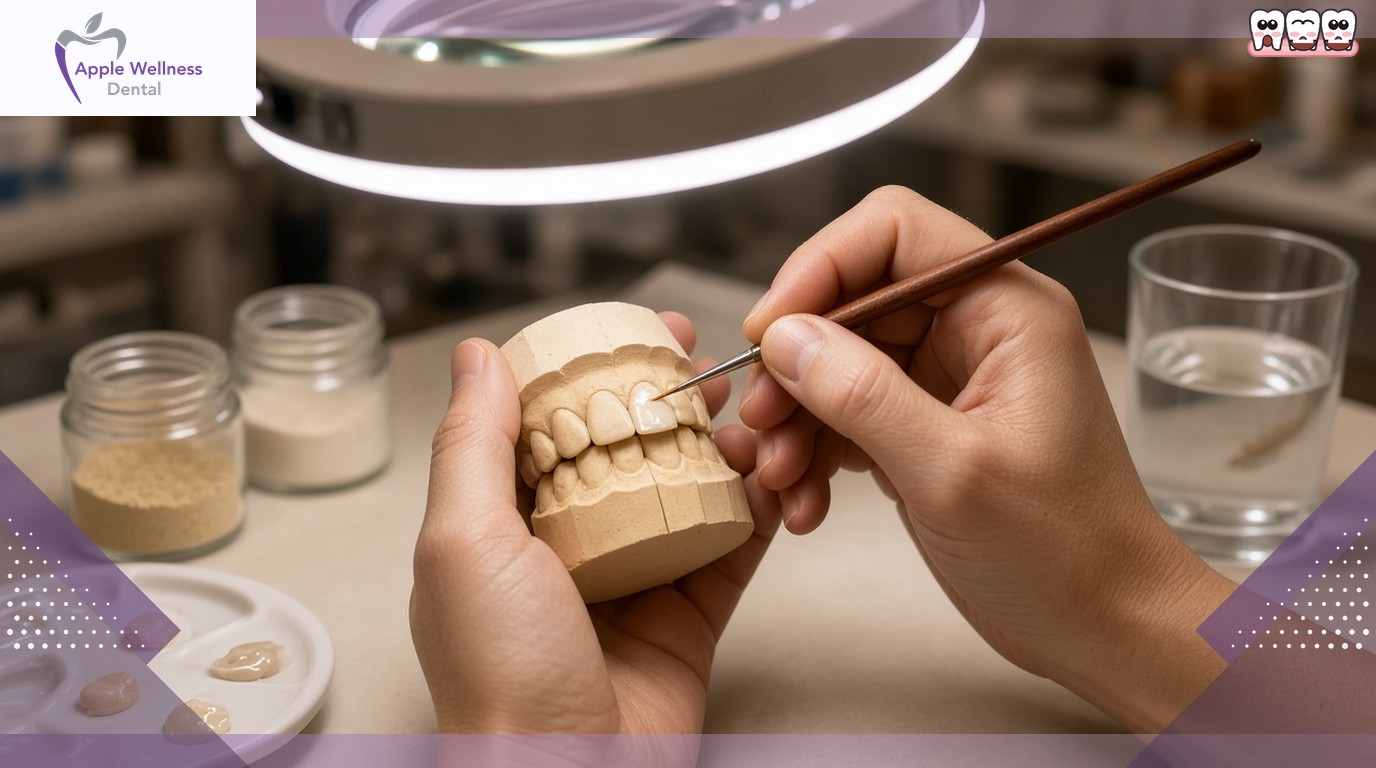
The CDA describes the porcelain process this way: the dentist removes a thin layer of enamel, takes a mould, fits temporary veneers and, at a follow-up visit, bonds the custom veneers to your teeth with dental cement. Cleveland Clinic adds that the lab can take a few weeks, and that at the second visit the dentist checks shape, colour and fit, bonds the veneers and adjusts your bite.
Before any of that, the teeth must be healthy. MouthHealthy says the dentist must first treat decay or gum disease, because placing veneers over unhealthy teeth may worsen existing problems. Any fillings or gum treatment needed first are separate costs. Our article on whether they shave your teeth for veneers explains the preparation step.
Porcelain vs. composite: why prices differ
Material is one of the biggest price levers. MouthHealthy says porcelain veneers are strong, long-lasting and natural-looking and tend to be the more expensive option. Composite veneers may need less enamel removed and fewer visits, and are easier to fix, but are not as stain- or wear-resistant. See our guide to composite veneers and bonding for more.
| Factor | Porcelain veneers | Composite resin veneers |
|---|---|---|
| Visits | At least 2 (CDA) | Can be done in 1 visit (CDA) |
| Lab work | Made in a dental lab from a mould or scan (CDA, MouthHealthy) | Often built directly on the tooth; lab-made versions also exist (Alberta Blue Cross codes 23122 and 27601) |
| Durability and stains | Generally last longer and resist stains better (CDA) | Easier to fix if damaged, but less stain- and wear-resistant (MouthHealthy) |
| Research on survival | 89% overall survival over a median 9 years for porcelain and glass-ceramic veneers (Morimoto et al., 2016) | 88% pooled survival in randomized trials followed 24 to 97 months (Lim et al., 2023) |
| 2026 Alberta Blue Cross listing | $870.97 + lab (27602) | $351.40 direct (23122) or $761.22 + lab (27601) |
The 2016 review also found that fracture or chipping was the most frequent complication (about 4%), followed by debonding (about 2%). In the 2023 composite review, surface roughness, colour mismatch and marginal discolouration were the most reported problems. These are averages from studies, not a prediction for your teeth.
Why insurance rarely softens the cost
With many treatments, insurance pays part of the bill. Veneers are different. The CDA says bonding or veneers are often considered cosmetic and may not be covered by your dental benefits plan. MouthHealthy says a veneer may not be covered unless it is deemed medically necessary, and Cleveland Clinic says veneers are not covered by most insurance. The Canadian Dental Care Plan coverage page lists crowns (with preauthorization) and fillings, but veneers are not among the services it lists.
The pattern is similar elsewhere: the NHS says veneers are generally only available privately in England unless you can show a clinical need. If a tooth is badly damaged, your dentist may recommend a crown instead, which can change what a plan covers. Our article on getting veneers covered by insurance explains how to ask.
The long-term cost: replacement and upkeep
When you ask why are veneers so expensive, it helps to think in years, not visits. Cleveland Clinic says veneers last 10 to 15 years on average with proper care. The CDA says that if a veneer chips or peels off, or if a cavity forms under it, the veneer must be redone, or a crown placed. It also says veneers are not reversible because enamel is removed, so once you start, you will need some kind of covering on those teeth for life. Read more in our guides on how long porcelain veneers last and whether veneers can be removed.
Habits affect how long you get from that investment. The CDA says grinding or clenching can damage veneers and advises against biting hard objects like ice or fingernails. MouthHealthy suggests a mouthguard for sports and caution with foods and drinks that stain, such as coffee, tea and red wine.
Questions to ask before you accept a veneer quote
- ☐ How many teeth are included, and is each veneer porcelain or composite?
- ☐ Are lab fees, temporaries, X-rays and follow-up adjustments included?
- ☐ Do I need fillings, gum treatment or whitening of other teeth first?
- ☐ Is there a more conservative option, such as bonding or whitening?
- ☐ What happens, and what does it cost, if a veneer chips or comes off?
- ☐ Can you send a pre-authorization to my insurer?
Be careful with prices that seem too good to be true. The ADA urges the public to be cautious of unlicensed “veneer technicians,” warning that unsupervised treatment can cause damaging complications. In Alberta, dentists are regulated by the College of Dental Surgeons of Alberta.
For a different angle on the same question, our earlier article asks whether veneers are expensive and what drives the price.
Veneers in Airdrie: how we handle cost questions
Apple Wellness Dental has provided dental care in Airdrie since 1993 from 229 1st Street SW. Veneers are part of the cosmetic services offered by our general dentists, Dr. Sanjay Rajpal and Dr. Hammad Qasim. If you are asking why are veneers so expensive, we can walk you through what your own plan would involve.
We follow the Alberta Dental Fee Guide, bill most private insurance providers directly, accept the Canadian Dental Care Plan (CDCP) for covered services and offer payment plans. We do not post a veneer price online, because the number of teeth, the material and any treatment needed first all change the total. We provide a written quote after an examination. Call (587) 332-6767 to book.
Frequently asked questions
Why are veneers so expensive compared with fillings?
A filling is usually done in one visit, while a porcelain veneer usually takes at least two visits, a mould or scan, temporary veneers and custom work in a dental lab. In the 2026 Alberta Blue Cross schedule, a lab-made porcelain veneer is listed at $870.97 with lab costs extra.
How much does one veneer cost in Alberta?
There is no single price. Alberta Blue Cross’s 2026 schedule lists $870.97 for a bonded porcelain veneer (code 27602) and $761.22 for a lab-made composite veneer (code 27601), each with lab costs extra. Dentists set their own fees, so ask for a written estimate after an exam.
Are composite veneers cheaper than porcelain?
Usually. The ADA’s MouthHealthy site says porcelain veneers tend to be the more expensive option, while composite veneers may need fewer visits. The CDA says porcelain lasts longer and resists stains better.
Does insurance or the CDCP pay for veneers?
Often not. The CDA says veneers are often considered cosmetic and may not be covered by dental plans, and veneers are not among the services listed on the CDCP coverage page. A dentist can send a pre-authorization to check.
How long do veneers last before I pay again?
Cleveland Clinic says veneers last 10 to 15 years on average with proper care. A 2016 review of porcelain and glass-ceramic veneers found an overall survival rate of 89% over a median follow-up of 9 years.
Is it worth travelling or choosing the cheapest quote?
Compare what is included, who places the veneers and what happens if one chips. The ADA warns against unlicensed “veneer technicians.” Because enamel is removed, veneers are not reversible, so the quality of planning matters.
Sources
- Alberta Blue Cross, “Alberta Blue Cross Dental Schedule 2026, General Practitioner” (2026): ab.bluecross.ca
- Alberta Dental Association, “Understanding Dental Fees” (undated): albertadentalassociation.ca
- Government of Alberta, “Dental fees in Alberta” (undated): alberta.ca
- Canadian Dental Association, “Bonding & Veneers” (undated): cda-adc.ca
- American Dental Association, MouthHealthy, “Veneers” (undated): mouthhealthy.org
- Cleveland Clinic, “Veneers” (last updated July 18, 2022): my.clevelandclinic.org
- Morimoto S, et al. “Main Clinical Outcomes of Feldspathic Porcelain and Glass-Ceramic Laminate Veneers: A Systematic Review and Meta-Analysis.” Int J Prosthodont (2016): pubmed.ncbi.nlm.nih.gov
- Lim TW, et al. “Survival and Complication Rates of Resin Composite Laminate Veneers: A Systematic Review and Meta-Analysis.” J Evid Based Dent Pract (December 2023): pubmed.ncbi.nlm.nih.gov
- Government of Canada, “Canadian Dental Care Plan: What is covered” (undated): canada.ca
- NHS, “Dental treatments” (last reviewed July 8, 2026): nhs.uk
Apple Wellness Dental
Dental care in Airdrie, Alberta. This article is general education and does not replace an examination by a dental professional. It is not medical, legal, tax or financial advice.
Thinking about veneers and want a clear estimate? Book a call or Contact Us, or call 587-332-6767.