
How to Stop Bleeding After Tooth Extraction: Home Remedies Checked Against the Evidence
Quick Answer: How to stop bleeding after tooth extraction home remedies start with pressure: bite on folded, damp gauze or a clean cloth for 20 to 30 minutes while sitting upright. If gauze runs out or pressure alone fails, a moistened black tea bag is an option. Call your dentist if heavy bleeding continues; call 911 for fainting or breathing trouble.
Searching for how to stop bleeding after tooth extraction home remedies usually turns up a long list: tea bags, ice, salt water, spices, oils. Some of these appear in official aftercare instructions. Others do not appear in any of the official sources we reviewed, and a few can make bleeding worse.
This article sorts the common remedies into what official sources support, what they only partly support and what they do not mention or advise against. For our general guide, see how to stop bleeding after tooth extraction. Always follow the instructions your own dentist gave you first.
Last updated: October 20, 2026. Main sources: CDA care after minor oral surgery (undated); MyHealth Alberta tooth extraction (reviewed 2025) and mouth wounds (July 31, 2024); Dartmouth Health post-operative instructions (undated); an NHS pharmacy dental factsheet (2022); and NHS hospital leaflets. Full links are at the end.
Key Takeaways
- Pressure comes first: bite on damp gauze or a clean cloth and do not peek; source timings range from 10 to 30 minutes per attempt.
- Tea bag is a backup: MyHealth Alberta and Dartmouth Health suggest a moistened tea bag; Dartmouth specifies black tea, not herbal or decaf.
- Do not rinse or spit in the first 24 hours (CDA, NHS pharmacy factsheet).
- Rest with your head raised (CDA, Kettering General Hospital NHS).
- Call your dentist if you are still bleeding a lot after 4 hours (CDA) or after 3 rounds of pressure (NHS pharmacy factsheet). Call 911 if someone faints or has trouble breathing (MyHealth Alberta).
How to stop bleeding after tooth extraction home remedies: the pressure method
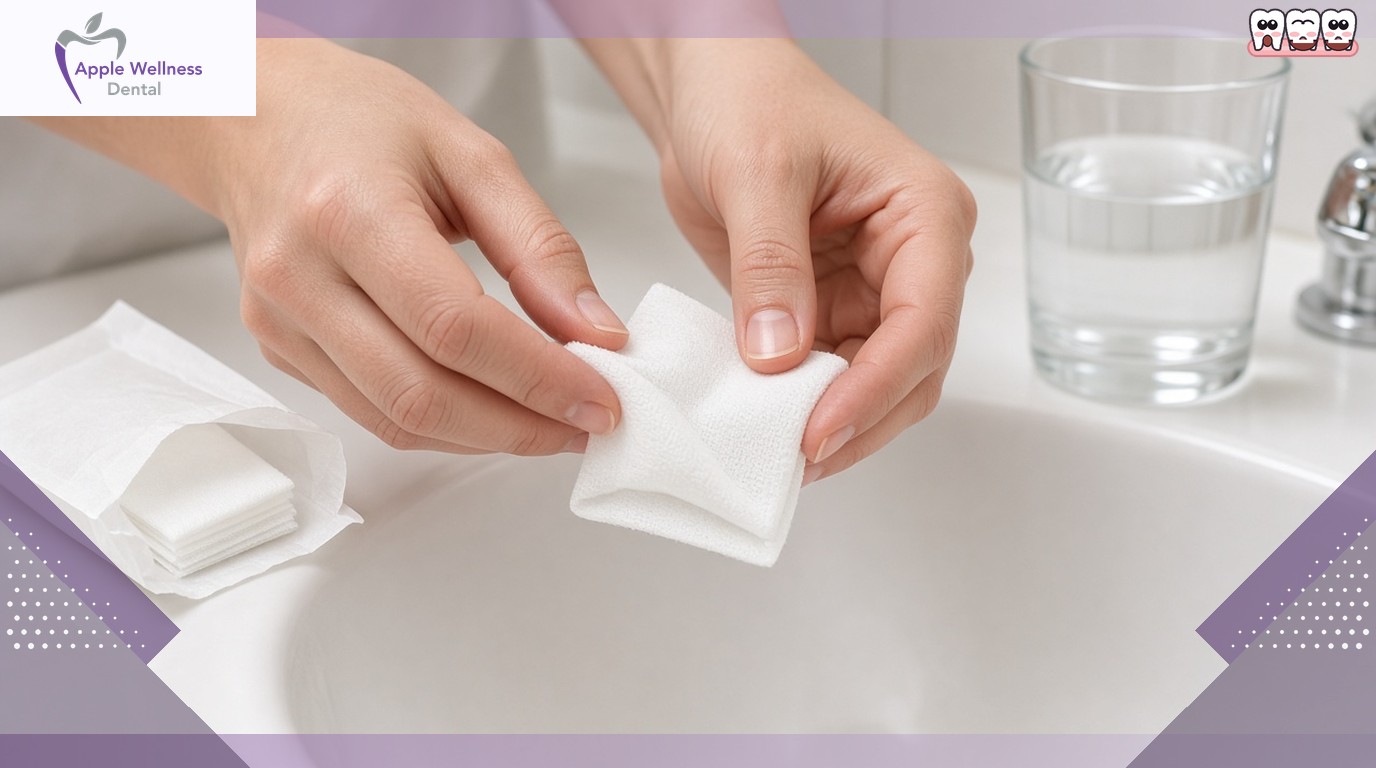
Pressure is the one home remedy every source agrees on. Combined from the sources below, the steps are:
- Wash your hands (WA Dental Health Services).
- Fold or roll a pad. Use clean gauze folded thick (MyHealth Alberta) or a clean, slightly damp cotton handkerchief or rolled gauze (NHS pharmacy dental factsheet). UHD NHS suggests dampening it with cooled boiled water.
- Place it directly over the socket, not just between your teeth.
- Sit upright and bite down firmly. The CDA says to rest and keep your head raised because rest slows blood flow.
- Hold it without checking. MyHealth Alberta says to use a clock and resist the urge to peek. If blood soaks through, add another pad without lifting the first.
- Do not talk or chew on the gauze. MyHealth Alberta says using gauze too long or talking with it in place can make you bleed more or for longer.
- Repeat with a fresh pad if needed, and stop using gauze once you cannot see any bleeding (MyHealth Alberta).
How long to hold pressure: what each source says
Sources give different times. Follow your own dentist’s instructions if they gave you a time.
| Source | Pressure time per attempt |
|---|---|
| NHS wisdom tooth removal | At least 10 minutes with a clean cloth or cotton wool |
| MyHealth Alberta (mouth wounds) | A full 15 minutes; then a moistened tea bag for 10 to 15 minutes if pressure is not working |
| CNWL NHS leaflet | 15 minutes without removing the gauze |
| Bedfordshire Hospitals NHS | At least 15 minutes, then a further 15 minutes if needed |
| UHD NHS | About 20 minutes continuously, then try again |
| NHS pharmacy dental factsheet | 20 to 30 minutes; after 3 attempts, see a dentist or call NHS 111 |
| WA Dental Health Services; Kettering General Hospital NHS | 30 minutes (WA); up to 30 minutes sitting upright (Kettering) |
| Canadian Dental Association | The first pad stays an hour with firm pressure, then a new pad for another hour if still bleeding |
| MyHealth Alberta (tooth extraction); Dartmouth Health | Change the pad every 30 to 60 minutes in the first 24 hours (MyHealth Alberta); every 30 minutes, usually stopping after 3 to 4 hours (Dartmouth) |
For more on timing, see how long to leave gauze in after tooth extraction.
Home remedies checked against the evidence
| Remedy | What the sources say | Our verdict |
|---|---|---|
| Gauze or clean cloth pressure | Recommended by every source we reviewed (CDA, MyHealth Alberta, NHS, Dartmouth Health and others). | Supported. Start here. |
| Damp tea bag | MyHealth Alberta: a dampened tea bag if you run out of gauze, or a moistened tea bag for 10 to 15 minutes if pressure does not stop bleeding. Dartmouth Health: a wet black tea bag, not herbal or decaf. | Supported as a backup to gauze. |
| Rest with head raised | CDA: rest and keep your head raised. Kettering: raise your head with an extra pillow when lying down to reduce bleeding risk. | Supported. |
| Ice pack on the cheek | Dartmouth Health: ice packs to the jaw in the first 24 hours can reduce pain, swelling and/or bleeding. Other sources mention cold packs for swelling. | Partly supported; outside the face only. |
| Salt water rinse | Do not rinse in the first 24 hours (CDA, Kettering, NHS pharmacy factsheet); rinsing can trigger fresh bleeding. Gentle rinses start after 24 hours. | Not for active bleeding on day 1. |
| Spices, oils, powders or other products packed into the socket | None of the official sources we reviewed recommends placing them in the socket. | Not supported. Do not use. |
| Aspirin for pain | CNWL: do not take aspirin because it may increase bleeding risk, unless it was prescribed. WA: avoid aspirin and ibuprofen. Other NHS leaflets list ibuprofen as suitable. | Ask your dentist or pharmacist; never stop a prescribed medicine on your own. |
Using a tea bag: what we know and what we don’t
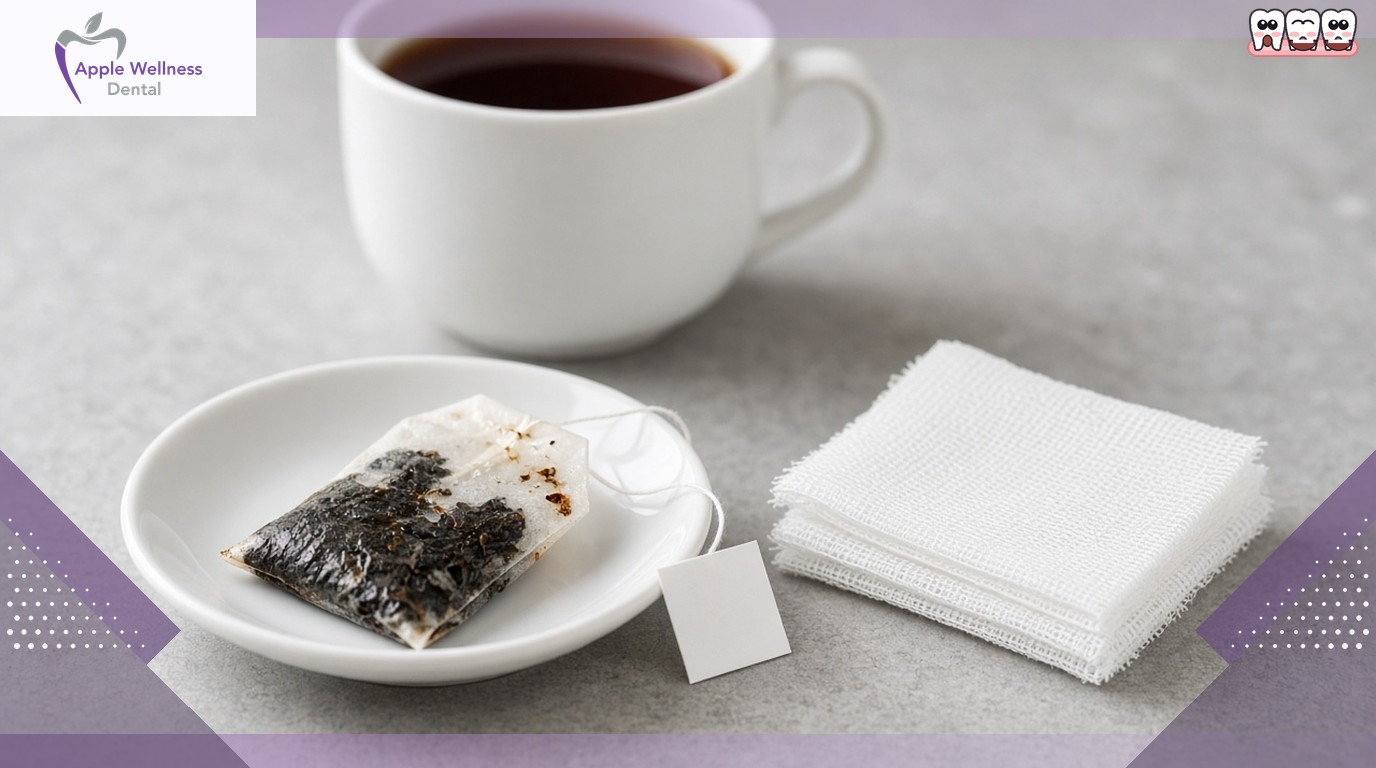
Based on the sources above:
- Use a regular black tea bag. Dartmouth Health names Salada or Lipton as examples and says not to use herbal or decaffeinated tea.
- Dampen it. MyHealth Alberta says “dampened” or “moistened.” Do not put a hot tea bag in your mouth; the CDA warns that hot liquids increase blood flow and can restart bleeding.
- Bite down gently but steadily over the socket for 10 to 15 minutes (MyHealth Alberta).
The research is limited. In a 2014 randomized trial of 62 patients having lower molars removed, Soltani and colleagues found that gauze soaked in green tea extract cut average bleeding time to 5.87 minutes, compared with 10.09 minutes for plain gauze. That study used green tea extract on sterile gauze, not a household black tea bag, so it does not prove a tea bag from your kitchen works the same way. A 2025 literature review describes tea bags as a topical option dental surgeons may use.
What makes bleeding worse
These are the habits the sources warn about in the first days:
- Spitting, straws and tobacco (MyHealth Alberta mouth wounds page).
- Rinsing in the first 24 hours (CDA, NHS pharmacy factsheet, Kettering).
- Hot drinks such as coffee and tea (CDA); the NHS pharmacy factsheet also says to avoid hot drinks.
- Exercise: MyHealth Alberta says no exercise for several days after mouth bleeding; UHD says no heavy lifting or exercise for a couple of days.
- Alcohol and tobacco for the first 2 weeks (CDA).
- Disturbing the clot with your toothbrush, sharp food or tongue (NHS pharmacy factsheet).
- Sleeping with gauze in. Dartmouth Health says not to leave gauze in overnight. MyHealth Alberta also warns to watch that gauze is not swallowed.
If bedtime is close and you are still oozing, see can I go to sleep if my tooth extraction is still bleeding.
Normal oozing or a problem? A quick guide
| What you see | What sources say | What to do |
|---|---|---|
| Pink or blood-stained saliva | Normal (NHS pharmacy factsheet). Blood mixed with saliva can look like more than it is (CDA). | Keep resting; avoid spitting. |
| Bleeding in the first hour or 2, oozing up to 24 hours | Expected (CDA). Light oozing is normal the day of surgery and sometimes the next day (MyHealth Alberta). | Gauze pressure as above. |
| Bleeding restarts later | Can happen (UHD). | Repeat pressure; call your dentist for new or more bleeding (MyHealth Alberta). |
| Still bleeding a lot after 4 hours, or after 3 rounds of pressure | Call your dentist (CDA); see a dentist or get urgent advice (NHS pharmacy factsheet). | Call your dentist now. |
| Fainting or trouble breathing | Call 911 (MyHealth Alberta). | Call 911. |
When to call your dentist, Health Link 811 or 911
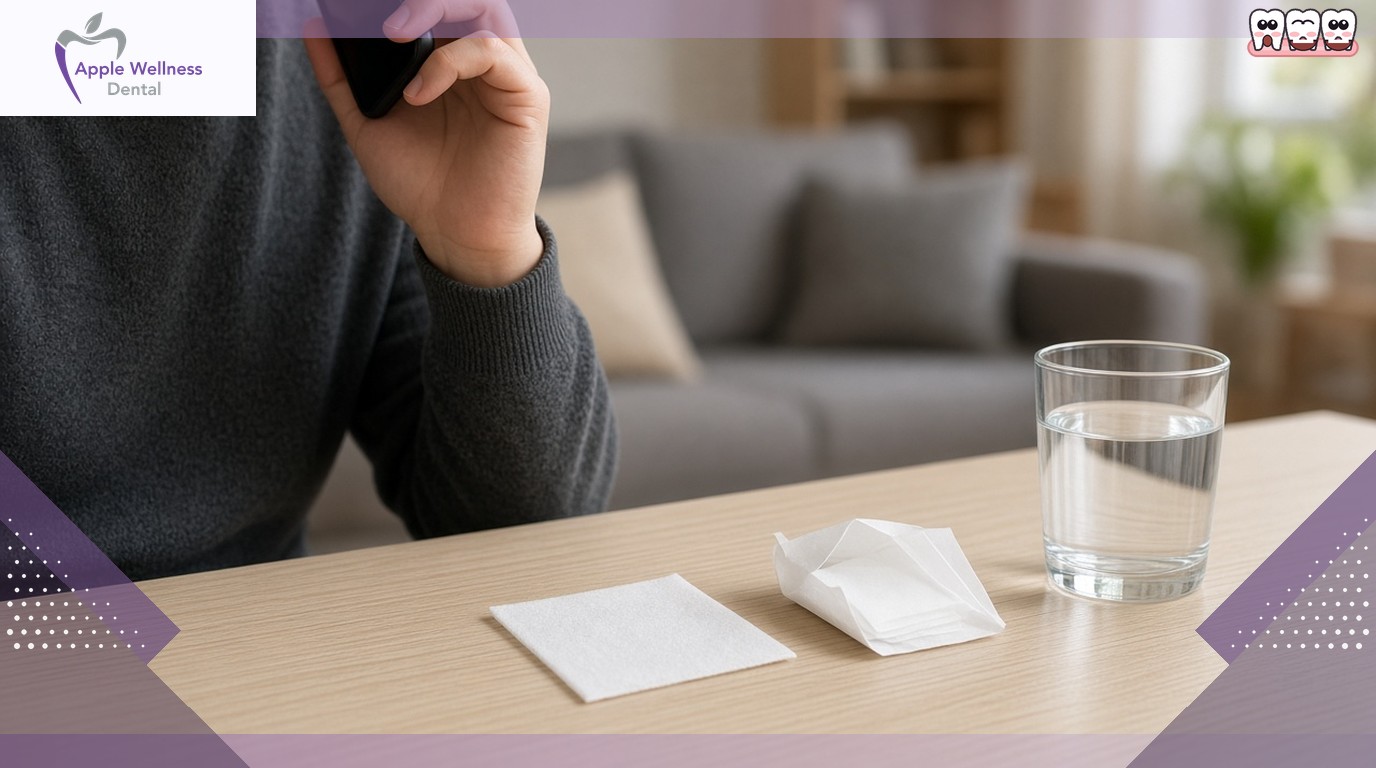
Home remedies are for normal, manageable bleeding. According to MyHealth Alberta aftercare instructions, call 911 if you pass out or have trouble breathing. Call your dentist now or seek immediate medical care if you have new or more bleeding from the site, pain that does not improve with pain medicine, loose stitches, or signs of infection such as increasing pain, swelling, warmth or redness, pus, red streaks or a fever.
Also call if you are still bleeding a lot 4 hours or more after the extraction (CDA). If you take blood thinners or have a bleeding condition, the NHS pharmacy factsheet says ongoing oozing needs urgent dental assessment. Our article on what happens if bleeding does not stop after tooth extraction explains what a dentist may do.
Outside office hours in Alberta, Health Link 811 is a free 24/7 line where registered nurses help you decide whether you need urgent care.
Hypothetical example: an evening ooze
Hypothetical example (not a real patient): Sam had a lower molar removed in the morning. In the evening Sam notices fresh bleeding after dinner. Sam sits upright, rolls a clean damp gauze pad, places it over the socket and bites for 30 minutes by the clock without checking. It is still oozing, so Sam tries a dampened black tea bag for 15 minutes. The bleeding slows to pink saliva. If it had kept bleeding heavily, the next step would have been calling the dentist’s after-hours line or Health Link 811.
Bleeding kit to have ready before your extraction
- ☐ Spare gauze swabs (the NHS pharmacy factsheet lists them as a pharmacy product).
- ☐ A few regular black tea bags, not herbal or decaf (Dartmouth Health).
- ☐ A clock or phone timer so you do not peek.
- ☐ An extra pillow to keep your head raised (Kettering) and an old pillowcase, since some stains on bed linen may be expected (Bedfordshire).
- ☐ Pain relief your dentist or pharmacist has approved for you.
- ☐ Your dentist’s phone number and the after-hours plan.
Extraction care in Airdrie
Apple Wellness Dental has provided dental care in Airdrie since 1993 from 229 1st Street SW. Our general dentists, Dr. Sanjay Rajpal and Dr. Hammad Qasim, provide tooth extractions and wisdom tooth removal, and our emergency dental treatment includes same-day emergency appointments when available. If you are working through how to stop bleeding after tooth extraction home remedies and the bleeding is not settling, call us at (587) 332-6767.
We follow the Alberta Dental Fee Guide, bill most private insurers directly and accept the Canadian Dental Care Plan (CDCP). For pain relief questions after an extraction, see our guide to the best painkiller for tooth extraction.
Frequently asked questions
What is the best home remedy to stop bleeding after a tooth extraction?
Firm, steady pressure. Every official source we reviewed starts with biting on folded, damp gauze or a clean cloth over the socket while sitting upright, usually for 10 to 30 minutes without checking. Other remedies are backups, not replacements.
Does a tea bag really stop bleeding after a tooth extraction?
MyHealth Alberta and Dartmouth Health both suggest biting on a moistened tea bag if gauze runs out or pressure alone is not working. A 2014 trial found gauze soaked in green tea extract shortened bleeding time, but it tested extract-soaked gauze, not household tea bags.
Which kind of tea bag should I use?
Dartmouth Health says to use a regular black tea bag (it gives Salada or Lipton as examples) and not herbal or decaffeinated tea. Dampen it rather than using it hot, since the CDA warns that hot liquids can restart bleeding.
How long is bleeding normal after a tooth extraction?
The CDA says you will probably bleed for the first hour or 2 and may ooze for up to 24 hours. If you are still bleeding a lot after 4 hours, call your dentist or oral surgeon.
Can I rinse with salt water to stop the bleeding?
Not in the first 24 hours. The CDA, Kettering General Hospital and the NHS pharmacy factsheet advise against rinsing or spitting during the first day because it can disturb the clot and trigger fresh bleeding. Gentle warm salt water rinses usually start after 24 hours.
What if I take blood thinners?
Tell your dentist before the extraction. Kettering General Hospital asks patients on anticoagulants to contact their anticoagulation clinic when they get a procedure date. The NHS pharmacy factsheet says ongoing oozing in people on anticoagulants needs urgent dental assessment. Do not stop a prescribed medication on your own.
Sources
- Canadian Dental Association, “Care after Minor Oral Surgery” (undated): cda-adc.ca
- MyHealth Alberta, “Tooth Extraction” (adaptation reviewed December 2, 2025): myhealth.alberta.ca
- MyHealth Alberta, “Tooth Extraction: Care Instructions” (current as of July 31, 2024): myhealth.alberta.ca
- MyHealth Alberta, “Mouth Wounds: How to Stop Bleeding” (current as of July 31, 2024): myhealth.alberta.ca
- Dartmouth Health, “Tooth Extraction (Post-Operative Instructions)” (undated): dartmouth-hitchcock.org
- NHS England Workforce, Training and Education (London), Pharmacy Dental Fact Sheet, “Bleeding after tooth extraction” (2022): london.wtepharmacy.nhs.uk
- NHS, “Wisdom tooth removal” (last reviewed June 12, 2024): nhs.uk
- University Hospitals Dorset NHS Foundation Trust, “Aftercare instruction after wisdom tooth removal” (March 2026): uhd.nhs.uk
- Kettering General Hospital NHS Foundation Trust, “Advice Following Oral Surgery Under Local Anaesthetic” (September 2024): kgh.nhs.uk
- Central and North West London NHS Foundation Trust, “Looking after your mouth after a dental extraction” (February 2023): oxfordhealth.nhs.uk
- Bedfordshire Hospitals NHS Foundation Trust, “Removal of Teeth, Post-Operative Care Advice” (undated): bedfordshirehospitals.nhs.uk
- Government of Western Australia, Dental Health Services, “Instructions following tooth extraction” (v09/25): dental.wa.gov.au
- Soltani R, et al. “Evaluation of the effect of green tea extract on the prevention of gingival bleeding after posterior mandibular teeth extraction: a randomized controlled trial.” Evid Based Complement Alternat Med. 2014: PMC4082946
- Ali FM. “Tea Bags for Controlling Postoperative Bleeding after Extraction of Teeth: A Review of Literature.” J Pharm Bioallied Sci. 2025: PubMed 40511044
- Primary Care Alberta, “Health Link 811” (undated): albertahealthservices.ca
Apple Wellness Dental
Dental care in Airdrie, Alberta. This article is general education and does not replace an examination by a dental professional or the instructions your dentist gives you. If bleeding is heavy or you feel faint, call your dentist or 911. It is not medical, legal, tax or financial advice.
Bleeding after an extraction that isn’t settling, or want to plan ahead for one? Book a call or Contact Us, or call 587-332-6767.