
How Much Do Dental Veneers Cost? Build Your Own Alberta Estimate
Quick Answer: How much do dental veneers cost depends on the material, the number of teeth and the lab. As a benchmark, the 2026 Alberta Blue Cross schedule lists $870.97 per porcelain veneer and $761.22 per lab-made composite veneer, plus lab fees, or $351.40 for a direct composite veneer. Your dentist’s written estimate is the real number.
How much do dental veneers cost is a question with no single price, because no official body publishes a retail veneer price for Alberta. What does exist is a public, dated fee schedule with procedure codes. This guide shows you how to use those benchmark numbers to build a rough worksheet for your own treatment, so you walk into a consultation knowing which line items to ask about.
Last updated: November 3, 2026. Main source: Alberta Blue Cross, “Alberta Blue Cross Dental Schedule 2026 – General Practitioner”. Full links are in the Sources section.
Key Takeaways
- There is no official retail price for veneers in Alberta. Government of Alberta says fee guide amounts are recommended, not mandatory.
- Benchmark fees exist. The 2026 Alberta Blue Cross schedule lists codes for porcelain, lab-made composite and direct composite veneers.
- Lab fees are extra for lab-made veneers. Codes marked [L] mean “Laboratory Procedures Extra”.
- Insurance often does not pay. The CDA says veneers are often considered cosmetic and may not be covered.
- Ask for a written estimate and a pre-authorization, as the Government of Alberta recommends.
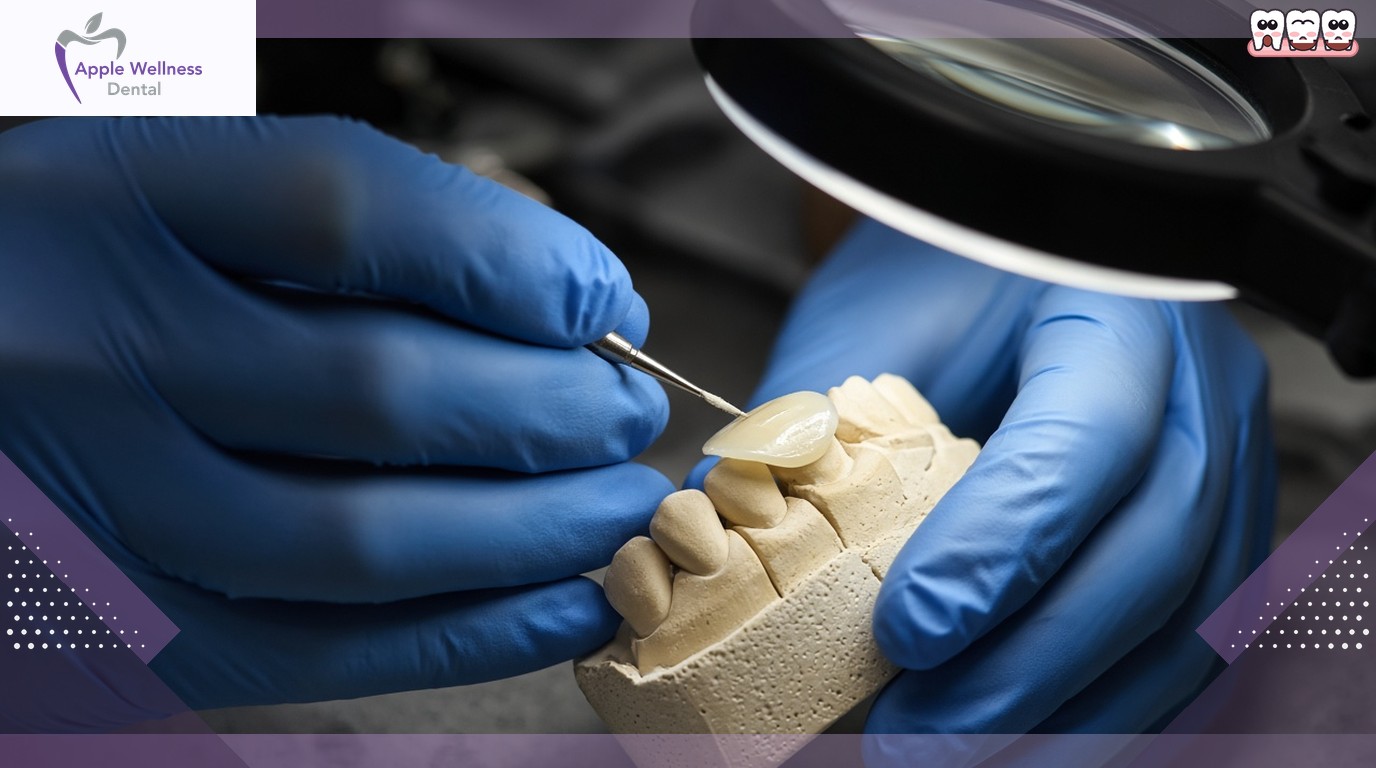
Where the benchmark numbers come from
Alberta Blue Cross publishes a dental schedule each year with a procedure code and fee for each service. It is used for certain government-sponsored programs, and it is one of the few public, dated sources of Alberta dental fees. It is not a price list for any one clinic. The Government of Alberta explains that “the fees in the dental guide are recommended, but are not mandatory” and that dentists continue to set their own fees.
With that caveat, here are the 2026 veneer-related codes:
| Code | Description (2026 ABCDS) | Benchmark fee |
|---|---|---|
| 27602 | Veneers, porcelain/ceramic/polymer glass, bonded [L] | $870.97 per tooth plus lab |
| 27601 | Veneers, acrylic/composite/compomer, bonded [L] | $761.22 per tooth plus lab |
| 23122 | Tooth-coloured veneer application, non-prefabricated direct buildup, bonded | $351.40 per tooth |
| 23123 | Tooth-coloured veneer application, diastema closure, interproximal only, bonded | $281.35 per tooth |
| 01103 | Complete oral examination | $119.11 |
| 02111 | Periapical radiograph, single image | $31.13 |
[L] in the schedule means “Laboratory Procedures Extra”. In plain terms, the lab that makes a porcelain or lab-made composite veneer charges a separate fee that is added to the dentist’s fee. Lab fees are not in the schedule, which is one reason two quotes can differ.
Porcelain, lab composite or direct composite?
The CDA explains that composite resin veneers can be done in a single visit, while porcelain veneers usually need at least two visits but generally last longer and resist stains better. For porcelain veneers, the dentist removes a thin layer of enamel, takes a mould and fits temporaries before the final veneers are bonded. Cleveland Clinic gives an average lifespan of 10 to 15 years with proper care.
| Type | Visits (CDA) | Benchmark code and fee | Extra to ask about |
|---|---|---|---|
| Porcelain | At least two | 27602: $870.97 per tooth | Lab fee, temporaries, shade matching |
| Lab-made composite | Usually two | 27601: $761.22 per tooth | Lab fee |
| Direct composite | Often one | 23122: $351.40 per tooth | Polishing and repair over time |
Learn more in our guides to composite veneers and how long porcelain veneers last.
Hypothetical example: a veneer cost worksheet
The table below is a hypothetical example using only 2026 ABCDS benchmark fees. It assumes one complete exam and two periapical X-rays before treatment. It does not include lab fees, any treatment needed first such as fillings or gum care, or follow-up visits. Real treatment plans vary.
| Scenario | Exam + 2 X-rays | Veneer benchmark | Subtotal before lab fees |
|---|---|---|---|
| 1 porcelain veneer | $181.37 | 1 x $870.97 = $870.97 | $1,052.34 |
| 2 porcelain veneers | $181.37 | 2 x $870.97 = $1,741.94 | $1,923.31 |
| 4 porcelain veneers | $181.37 | 4 x $870.97 = $3,483.88 | $3,665.25 |
| 6 porcelain veneers | $181.37 | 6 x $870.97 = $5,225.82 | $5,407.19 |
| 4 lab-made composite veneers | $181.37 | 4 x $761.22 = $3,044.88 | $3,226.25 |
| 4 direct composite veneers | $181.37 | 4 x $351.40 = $1,405.60 | $1,586.97 (no lab fee) |
Hypothetical example: Someone wants to brighten their four upper front teeth. Using the worksheet, porcelain benchmarks come to $3,665.25 before lab fees, and direct composite to $1,586.97. At their consultation they ask for a written estimate for both options, including the lab fee and any work needed first. They then ask the clinic to send a pre-authorization to their insurer before deciding.
Hypothetical example: cost per year of wear
Upfront price is only part of the picture. Spreading the benchmark fee over the 10 to 15 year average lifespan that Cleveland Clinic gives can help you compare options. This is a hypothetical example using benchmark fees only, before lab fees, and actual lifespan depends on your bite, habits and care.
| Option | Benchmark fee per tooth | Over 10 years | Over 15 years |
|---|---|---|---|
| Porcelain (27602) | $870.97 plus lab | About $87 per year | About $58 per year |
| Lab-made composite (27601) | $761.22 plus lab | About $76 per year | About $51 per year |
Direct composite veneers cost less upfront, but the CDA notes that porcelain generally lasts longer and resists stains better. Composite may need polishing, repair or replacement sooner, so it is worth asking your dentist how long they would expect each option to last in your mouth.
Protecting the money you spend
Veneers need the same daily care as natural teeth. The CDA advises brushing and flossing daily and avoiding biting hard objects like ice or fingernails. Cleveland Clinic suggests cutting up hard or crunchy foods such as apples, carrots and tough meats rather than biting into them. If you grind or clench, ask about a night guard, since the CDA notes grinding can damage veneers. Regular exams and cleanings let your dentist catch small chips or wear early. Remember too that the CDA says veneers are not reversible, because enamel is removed underneath.
What changes the final price
- Number of teeth. Veneer fees are per tooth, so the total scales quickly.
- Material and lab. Porcelain and lab-made composite add a lab fee; direct composite does not.
- Treatment needed first. The CDA notes your dentist may suggest other treatments if a tooth has decay or gum disease, or if there is not enough enamel to bond.
- Grinding. The CDA notes grinding or clenching can damage veneers, so a night guard may be recommended.
- Clinic fees. Dentists may charge above or below the fee guide, according to the Government of Alberta.
- Whitening first. Veneers do not respond to bleach, so if you plan to whiten natural teeth, it is usually done before shade matching. See can you whiten veneers safely.
Will insurance or CDCP pay?
The CDA says bonding or veneers “are often considered cosmetic and may not be covered by your dental benefits plan.” Cleveland Clinic also notes that veneers are cosmetic and not covered by most insurance. Some plans may contribute when a veneer restores a damaged tooth rather than purely improving appearance, so the only way to know is to check your plan.
The Canadian Dental Care Plan focuses on preventive, diagnostic, restorative and other medically necessary care. Cosmetic treatment is not part of its coverage list, so assume CDCP will not pay for cosmetic veneers and confirm with the plan directly. For more, see how to get veneers covered by insurance.
If your plan does contribute, it will usually pay a percentage of its own allowed fee, not of the clinic fee, and annual maximums often apply. A pre-authorization is the simplest way to see the dollar amount your plan would pay before any work begins, so you know your share in advance and can plan around your annual maximum.
Questions to ask before you commit
- ☐ Is the estimate in writing, with every procedure code listed?
- ☐ Does the estimate include the lab fee, and which lab is used?
- ☐ Are temporaries, try-ins and follow-up visits included?
- ☐ Is any treatment needed first, such as fillings or gum care?
- ☐ Do you charge according to the Alberta Dental Fee Guide?
- ☐ Can you send a pre-authorization to my insurer?
- ☐ Are payment plans available?
- ☐ What is the plan if a veneer chips or debonds?
For why veneer fees are what they are, see why are veneers so expensive.
Veneer consultations in Airdrie
At Apple Wellness Dental, Dr. Sanjay Rajpal and Dr. Hammad Qasim start with an exam to check whether veneers are the right fit, then provide a written estimate. Our clinic at 229 1st Street SW follows the Alberta Dental Fee Guide, direct bills insurance, can send pre-authorizations and offers payment plans. Call (587) 332-6767 to book; we do not offer online booking. See our full list of dental services.
Frequently asked questions
How much does one porcelain veneer cost in Alberta?
There is no official retail price. As a benchmark, the 2026 Alberta Blue Cross schedule lists code 27602 at $870.97 per porcelain veneer, plus a separate lab fee. Your dentist’s written estimate will give your actual cost.
Are composite veneers cheaper than porcelain?
Usually. The 2026 ABCDS benchmarks list direct composite veneers (23122) at $351.40 per tooth with no lab fee, compared with $870.97 plus lab for porcelain (27602).
Does insurance cover dental veneers?
Often not. The CDA says veneers are often considered cosmetic and may not be covered by your dental benefits plan. Ask your dentist to send a pre-authorization to check.
Does the Canadian Dental Care Plan cover veneers?
Cosmetic treatment is not among CDCP covered services. Confirm with the plan if a veneer is being proposed to restore a damaged tooth.
Why do veneer quotes vary between clinics?
The Government of Alberta says fee guide amounts are recommended, not mandatory, and dentists set their own fees. Lab fees, materials and treatment needed first also differ.
How long do veneers last?
Cleveland Clinic gives an average of 10 to 15 years with proper care. The CDA notes porcelain generally lasts longer and resists stains better than composite.
What does [L] mean on a dental fee schedule?
In the Alberta Blue Cross schedule, [L] means “Laboratory Procedures Extra”, so a separate lab fee is added to the listed fee.
Sources
- Alberta Blue Cross, “Alberta Blue Cross Dental Schedule 2026 – General Practitioner”
- Government of Alberta, “Dental fees in Alberta” (undated)
- Canadian Dental Association, “Bonding and Veneers” (undated)
- Cleveland Clinic, “Veneers” (last updated July 18, 2022)
- Government of Canada, “Canadian Dental Care Plan: What is covered” (undated)
Apple Wellness Dental
Dental care in Airdrie, Alberta. This article is general education and does not replace an examination by a dental professional. It is not medical, legal, tax or financial advice.
Want a written veneer estimate? Call our Airdrie team. Book a call or Contact Us, or call 587-332-6767.