
Dental Implants vs. Bridges: Which Tooth Replacement is Better in 2026?
When faced with a missing tooth, patients inevitably ask: is a dental implant better than a bridge? The definitive answer is that dental implants are generally superior for long-term oral health because they replace the tooth root, preserving jawbone density and leaving adjacent teeth untouched. However, a dental bridge may be the better choice for patients who lack sufficient bone density, require a faster restoration, or have adjacent teeth that already need dental crowns.
Key Takeaways
- Longevity: Dental implants can last a lifetime with proper care, while bridges typically need replacement every 10 to 15 years.
- Bone Health: Implants stimulate the jawbone to prevent bone resorption; bridges only sit above the gumline.
- Tooth Preservation: Bridges require shaving down healthy adjacent teeth, whereas implants are standalone restorations.
- Procedure Time: Bridges can be completed in a few weeks, while implants require a multi-month healing process called osseointegration.
- Cost: Implants have a higher upfront cost but often provide a better long-term return on investment due to their durability.
Understanding Your Tooth Replacement Options
To make an informed decision about common restorative dentistry options, it is crucial to understand the fundamental mechanics of both treatments. Modern dentistry has advanced significantly by 2026, offering highly realistic and functional solutions for tooth loss.
What is a Dental Implant?
A dental implant is a comprehensive artificial tooth system. It consists of a biocompatible titanium post surgically embedded into the jawbone, an abutment (connector), and a custom-made porcelain crown. According to the American College of Prosthodontists, implants are the closest replica to natural tooth structure available today. Because the titanium post fuses with the living bone—a process known as osseointegration—it provides unparalleled stability.
What is a Dental Bridge?
A traditional dental bridge spans the gap created by one or more missing teeth. It consists of a false tooth (called a pontic) held in place by dental crowns cemented onto the healthy teeth adjacent to the gap (called abutment teeth). While highly aesthetic and functional, a bridge only replaces the visible portion of the tooth, not the underlying root structure.
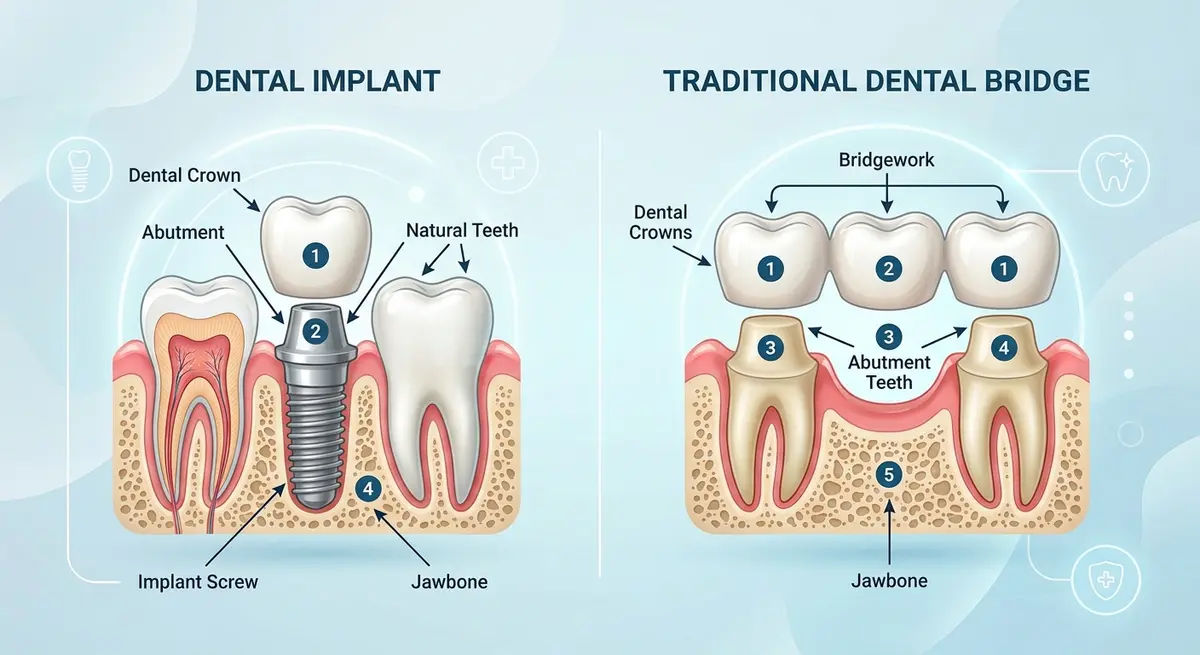
Head-to-Head Comparison: Implants vs. Bridges
Choosing between these two treatments requires weighing several clinical and lifestyle factors. The table below outlines the primary differences between the two modalities.
| Feature | Dental Implant | Dental Bridge |
|---|---|---|
| Lifespan | 25+ years to a lifetime | 10 to 15 years on average |
| Bone Preservation | Excellent (prevents bone loss) | Poor (bone loss continues beneath pontic) |
| Impact on Adjacent Teeth | None (standalone structure) | Requires enamel removal from healthy teeth |
| Treatment Timeline | 3 to 6 months | 2 to 4 weeks |
| Maintenance | Brush and floss like natural teeth | Requires special floss threaders |
Why Dental Implants Are Often Considered the Superior Choice
From a purely clinical standpoint, most dental professionals advocate for implants when the patient is a suitable candidate. The primary advantage lies in bone preservation. Research published by the National Institutes of Health (NIH) indicates that the jawbone can lose up to 25% of its width in the first year following tooth loss. Because an implant mimics a natural root, it provides the necessary mechanical stimulation to keep the jawbone dense and healthy.
Furthermore, implants protect your remaining natural teeth. “By avoiding the need to alter adjacent healthy teeth, dental implants represent a more conservative approach to tooth replacement, despite the surgical component,” explains Dr. Thomas Salinas, a prosthodontist at the Mayo Clinic. When a bridge is placed, the supporting teeth bear the chewing force of the missing tooth, which can increase the risk of fractures or decay over time.
When considering the lifespan of restorative treatments, implants boast an impressive 98% success rate over a 10-year period. While the crown on top may eventually need replacement due to normal wear, the titanium post itself is designed to last a lifetime.
When a Dental Bridge Makes More Sense
Despite the structural advantages of implants, bridges remain a highly relevant and effective treatment in 2026. A bridge might be the preferred option under several specific circumstances.
First, if a patient has experienced significant bone loss and does not wish to undergo bone grafting surgery, a bridge provides a secure alternative. Second, if the teeth adjacent to the gap already have large fillings or extensive decay, they will likely need crowns anyway. In this scenario, utilizing them as abutments for a bridge solves two dental issues simultaneously.
Additionally, patients with certain systemic health conditions, such as uncontrolled diabetes or autoimmune disorders, may have compromised healing capabilities. In these cases, avoiding the surgical placement of an implant reduces the risk of post-operative complications.

The Step-by-Step Process for Each Procedure
Understanding what happens in the dental chair can alleviate anxiety and help you make the right choice. Both procedures require careful planning, but their execution differs vastly.
The Dental Implant Process
The dental implant placement process is a multi-stage journey that requires patience:
- Initial Consultation and 3D Imaging: The dentist uses CBCT scanners to evaluate bone density and map the exact placement of the implant.
- Extraction and Grafting (If Necessary): If the damaged tooth is still present, it is removed. Bone grafting may be performed simultaneously to build a solid foundation.
- Surgical Placement: The titanium post is surgically inserted into the jawbone. Patients often wonder how long dental freezing lasts after this step; typically, local anesthesia wears off within 2 to 4 hours.
- Osseointegration: A healing period of 3 to 6 months allows the bone to fuse completely with the titanium post.
- Abutment and Crown Placement: Once healed, an abutment is attached, followed by the final custom porcelain crown.
The Dental Bridge Process
The bridge procedure is significantly faster, usually completed in just two visits:
- Preparation of Abutment Teeth: The dentist administers local anesthesia and carefully reshapes the adjacent teeth by removing a portion of the enamel to make room for the crowns.
- Digital Impressions: Highly accurate digital scans are taken to ensure the bridge fits perfectly.
- Temporary Bridge Placement: A temporary acrylic bridge is placed to protect the exposed teeth while the permanent restoration is fabricated in a dental lab.
- Final Cementation: About two weeks later, the temporary bridge is removed, and the permanent ceramic or porcelain bridge is bonded into place.
Cost Analysis and Long-Term Value in 2026
Cost is frequently the deciding factor for patients. In 2026, a single dental implant typically ranges from $3,000 to $5,000 from start to finish. In contrast, a three-unit dental bridge generally costs between $2,000 and $4,000.
However, looking solely at the initial price tag is misleading. Because a bridge typically requires replacement every 10 to 15 years, the lifetime cost of a bridge often exceeds that of an implant. Furthermore, if the abutment teeth supporting a bridge fail due to recurrent decay, the patient may eventually require multiple implants or traditional dentures to restore their smile.
Insurance coverage also plays a role. While many dental insurance plans now cover a portion of implant therapy, bridges are still more universally covered under standard policies. It is highly recommended to consult with your provider before making a final decision.
Edge Cases and Risk Factors
No dental procedure is universally perfect. Certain lifestyle factors and medical conditions can influence the success of your chosen restoration.
- Smoking: Tobacco use significantly restricts blood flow to the gums. According to the American Dental Association, smokers face a failure rate for dental implants that is up to 20% higher than non-smokers.
- Bruxism (Teeth Grinding): Severe teeth grinding can chip the porcelain on both bridges and implants. However, the excessive force can also cause an implant to fail to integrate with the bone during the healing phase.
- Periodontal Disease: Active gum disease must be treated before either procedure. Implants placed in infected gums can develop peri-implantitis, a condition that leads to rapid bone loss and implant failure.
If you are preparing for oral surgery, your dentist will conduct a comprehensive medical history review to mitigate these risks.

Frequently Asked Questions (FAQ)
Is the dental implant procedure painful?
Most patients report that implant surgery is less painful than a tooth extraction. The procedure is performed under local anesthesia, and post-operative discomfort is typically managed effectively with over-the-counter pain relievers.
Can I eat normally with a dental bridge?
Yes, once fully cemented, a dental bridge restores your ability to chew most foods. However, you should avoid extremely hard or sticky foods that could dislodge or fracture the pontic. Knowing what to eat after a tooth extraction and subsequent restorative work is vital for protecting your new teeth.
Do dental implants look natural?
Modern dental implants are virtually indistinguishable from natural teeth. The crowns are custom-shaded and shaped to match your surrounding dentition perfectly, reflecting light exactly as natural enamel does.
How do I clean under a dental bridge?
Because the false tooth sits on top of the gums, you cannot floss normally between the teeth. You must use a floss threader, interdental brush, or a water flosser to clean beneath the pontic and prevent plaque buildup.
Am I too old for dental implants?
Age is rarely a limiting factor for dental implants. As long as you are in good general health and have sufficient bone density (or are a candidate for bone grafting), you can receive implants well into your 80s or 90s.
Will my body reject a titanium implant?
Titanium is highly biocompatible, meaning the body rarely recognizes it as a foreign object. True titanium allergies are exceptionally rare, affecting less than 0.6% of the population.
Conclusion
When evaluating whether a dental implant is better than a bridge, the answer ultimately depends on your unique clinical needs, budget, and timeline. Dental implants offer unmatched longevity, preserve your jawbone, and protect your surrounding teeth, making them the gold standard for tooth replacement in 2026. Conversely, dental bridges offer a faster, non-surgical solution that is highly effective for patients with specific anatomical limitations or immediate aesthetic needs.
The best way to determine which option is right for your smile is through a comprehensive clinical evaluation. If you are dealing with a missing tooth and want to explore your restorative options, contact us today to schedule a personalized consultation with our expert team.